Companion video (YouTube): original English narration, switchable Chinese dubbing, Chinese and English subtitles
The starting point of this series is a teacher of mine. He is always willing to share something with everyone on WeChat Moments.
I am not an expert, nor a professor, just a person who likes science. In the age of artificial intelligence I often feel lost, but I have not given up the things I love.
This series is dedicated to people who are just as lost: to those who dare to face the unknown, to those who walk into the unknown to explore it, and also to those who have never stopped, who keep walking toward their dreams.
And let us also not forget those pioneers.
In late summer 1896, in a laboratory of Leiden University, a flame sprinkled with salt was placed between the two poles of an electromagnet, and the two yellow lines in the flame widened. This episode first tells what was seen, the two men who made the discovery, and how the news spread, then how Lorentz explained it and how Zeeman wrote a sign the wrong way round, then derives the whole thing from the beginning with equations, and finally tells of the prize of 1902, and of a story that circulates online.
A flame sprinkled with salt
First, an experiment. Sprinkle a little table salt into the flame of a spirit lamp, and the flame turns a bright yellow. This yellow light comes from sodium.
Let the light pass through a narrow slit and then fall on a grating. A grating is ruled with a great many fine parallel lines; light of different colors falling on it is thrown off at different angles, and so it spreads out into a spectrum. Where the yellow is, there are two bright lines very close together, which physicists call the sodium D lines. Every element has its own set of spectral lines, like a fingerprint.
Now put this flame between the two poles of a very strong electromagnet, and switch on the current. The two yellow lines widen. Switch off the current, and they go back to what they were.
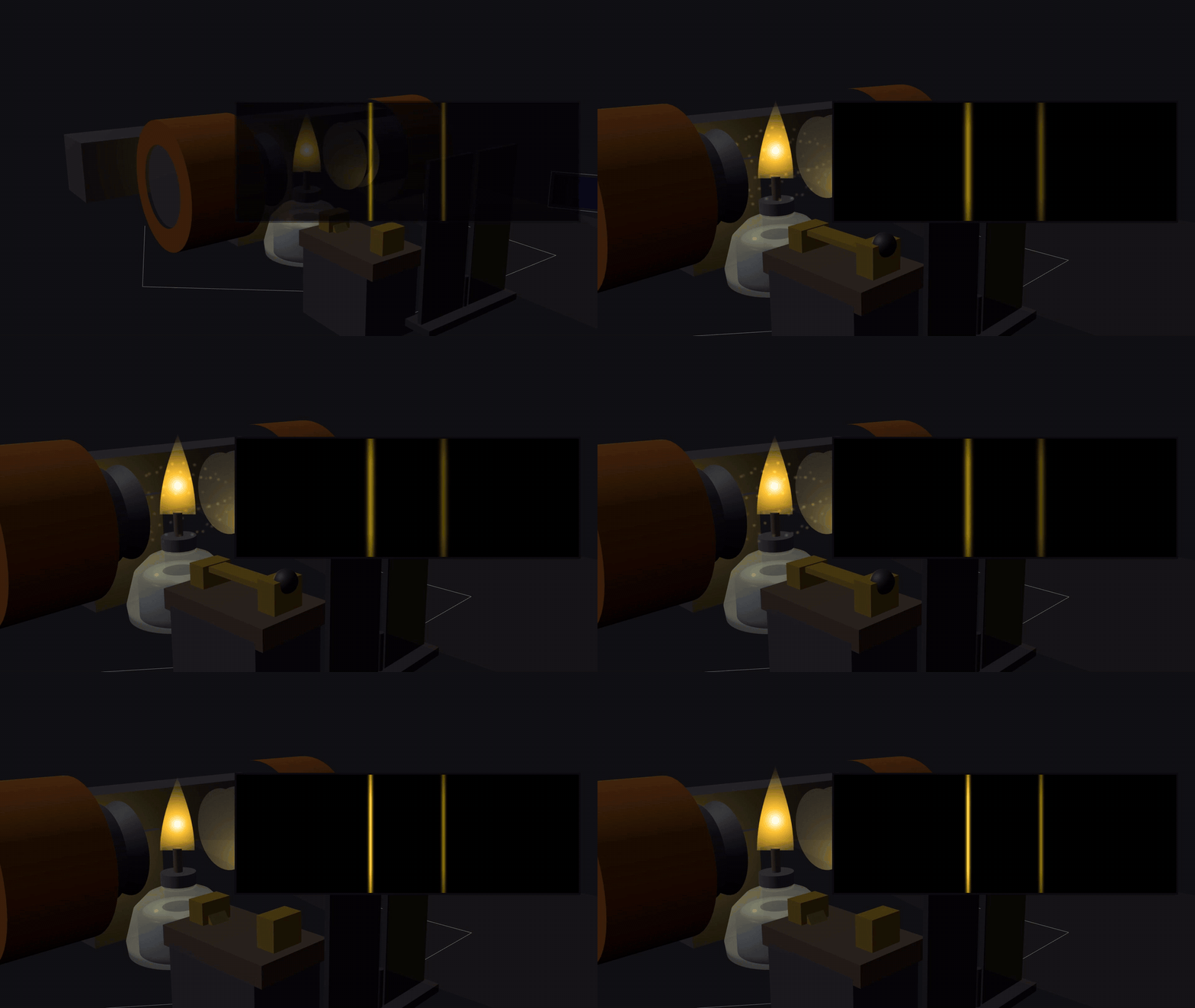
Figure 1. Switch on the electromagnet and the two yellow sodium lines widen; switch off the current and they go back to what they were.
The change is very small; Zeeman later said in his Nobel lecture that it was only about a thirtieth of the distance between the two lines. But it really does change, and it follows the current on and off.
If you take a finer, clearer spectral line instead, such as a blue line of cadmium, and look with better apparatus, you can see what it turns into: seen from the side, one line splits into three; seen along the direction of the magnetic field, it splits into two. This is what the gratings of the time showed. By today’s calculation, this blue line seen from the side actually splits into six, and seen along the field into four; it is just that the pairs lying close together cannot be told apart (Appendix A.5 gives the calculation).

Figure 2. With a blue line of cadmium instead: seen from the side, one line splits into three; seen along the direction of the magnetic field, it splits into two.
The magnet changed the light. More precisely, it changed the thing that gives out the light.
In 1885 a Belgian physicist had also seen the spectral lines of a flame widen in a magnetic field, but he thought it was because the flame had grown hotter. The first to show that this was the magnet directly changing the emission of light was a young assistant at Leiden University in the Netherlands, Pieter Zeeman. He said in his Nobel lecture that this was in August 1896.
The two men
Zeeman, though, was not the first to think of this experiment.
On March 12, 1862, in the laboratory of the Royal Institution in London, Michael Faraday used a spectroscope to see whether a magnet could change a light source. He saw nothing. The Life and Letters of Faraday by Bence Jones, published in 1870, says that this was the last experiment Faraday made.
Eight years later, on September 15, 1870, James Clerk Maxwell gave an address at the British Association for the Advancement of Science in Liverpool, and spoke of the small things that make up matter: their mass and the period of their vibration, no power in nature could alter in the least.
Zeeman had tried it once himself a few years earlier, and had seen nothing. In his English paper of 1897 he wrote that, had he not read some two years before a short sketch of Faraday’s life written by Maxwell, he would probably not have tried again so soon. That sketch says that in 1862 Faraday’s last experiment was a study of precisely the relation between magnetism and light: he wanted to see whether a strong magnet could change the lines in the spectrum of a flame, and did not succeed. Zeeman also said in his Nobel lecture that it was not simply out of a spirit of contradiction that he put the light source into a magnetic field; the idea had in fact come to him while he was studying the Kerr effect.
Zeeman
Zeeman was born in 1865 in Zonnemaire, a small village in the province of Zeeland in the Netherlands; his father was the local minister. In November 1882, at seventeen, he saw a strange white arc of light in the sky over his home village and wrote a letter describing it. In January of the following year this description was quoted in the British journal Nature.
To prepare for university he went to Delft to catch up on the classical languages, and there he met Heike Kamerlingh Onnes, who was by then already professor of physics at Leiden University. In 1885 Zeeman entered Leiden too.
First, a word here that will be needed later. Light is a wave, and the direction of its vibration is at right angles to the direction it travels. If the vibration always goes back and forth along the same straight line, this is called linear polarization; if the direction of the vibration keeps turning round as the light moves forward, it is called circular polarization.
In 1893 Zeeman received his doctorate, with a thesis measuring the Kerr effect: when light is reflected from a magnetized mirror surface of iron, cobalt or nickel, its polarization changes. This was one of the few connections between magnetism and light known at the time. In 1895 he married Johanna Elisabeth Lebret. The following year he made that discovery.
His life went roughly as follows. Each entry is followed by its sources; where several accounts do not agree, all of them are given.
- May 25, 1865 Born in Zonnemaire, Zeeland. Father Catharinus Forandinus Zeeman, the local minister according to the official biography; mother Willemina Worst (spelled Wilhelmina in the official biography). [Zonnemaire birth register (archive index); official Nobel Prize biography]
- January 1883 The passage in which he described, in a letter, the aurora he had seen in his home village the previous November was quoted in an article in Nature, volume 27 (the author of the article was Groneman, not Zeeman himself). [Nature 27 (1883-01-25), p.296]
- c. 1883–1885 Attended the HBS (hogereburgerschool) in Zierikzee, then went to Delft to catch up on the classical languages with J. W. Lely, where he met Kamerlingh Onnes; entered Leiden University in 1885. [official biography]
- c. 1890–1896 Assistant at Leiden. Whose assistant he was is told differently: the official biography says Lorentz’s assistant; A. J. Kox’s research says the assistant of both Lorentz and Onnes; in the preface to his own doctoral thesis he says to Lorentz “also as your assistant” and to Onnes “as a student of your laboratory” (translated). [thesis preface; official biography; Kox 1997]
- January 18, 1893 Defended his doctoral thesis at Leiden, “Measurements of the Kerr phenomenon in polar reflection from surfaces of iron, cobalt and nickel” (translated title). Afterwards spent a semester in Strasbourg. [thesis title page; official biography]
- 1894 or 1895 Admitted as privaatdocent (private lecturer) at Leiden. The ministerial decision published in the government gazette is dated January 11, 1894; the official biography gives 1895. [Staatscourant 1894-01-12; official biography]
- March 28, 1895 Married Johanna Lebret in Dordrecht. [Dordrecht marriage register (archive index)]
- 1896 First saw the spectral lines widen: his Nobel lecture says August; Kox, reading his laboratory notebook, records September 2. On October 31 and November 28, two papers were presented one after the other at the Royal Netherlands Academy of Sciences in Amsterdam. [Zeeman’s Nobel lecture; Kox 1997; KNAW Verslagen 5]
- December 3, 1896 The Amsterdam city council appointed him lecturer at the University of Amsterdam, taking up the post on January 1, 1897 (the official biography gives 1897). In 1900 he was promoted to extraordinary professor. [Dutch newspapers of the time, Delpher; official biography]
- 1902–1903 Shared the 1902 Nobel Prize in Physics with Lorentz; did not go to Stockholm because of illness, and gave his Nobel lecture belatedly on May 2, 1903. In 1908 he succeeded van der Waals as professor. [official Nobel Prize pages; official biography]
- June 18, 1923 Amsterdam opened the new physics laboratory built for him, and he spoke at the opening ceremony. The building was later called the Zeeman Laboratory. [Het Volk 1923-06-19; Dutch national monuments register 518497]
- 1935–1943 Reached retirement age in 1935 and retired. Died in Amsterdam on October 9, 1943, aged 78; buried on October 12 in the Kleverlaan cemetery in Haarlem, the same cemetery as Lorentz. [official biography; obituaries and news reports of the time, Delpher]
Lorentz
The other man was Hendrik Antoon Lorentz. He was born in 1853 in Arnhem in the Netherlands, where his father ran a nursery garden. He studied at Leiden, and received his doctorate in 1875 with a thesis on the reflection and refraction of light. Two years later Leiden University asked him to be its professor of theoretical physics; he was 24 that year.
At that time nobody yet knew what was inside the atom, and the electron had not yet been discovered either. Yet as early as 1892 Lorentz proposed that all bodies contain great numbers of small particles carrying positive or negative charge, and that electrical phenomena are in fact these particles in motion. According to his theory, light too is given out by the vibration of these particles.
- July 18, 1853 Born in Arnhem. Father Gerrit Frederik Lorentz, whose occupation in the birth register is given as tuinman (gardener), and in the official biography as nursery owner; mother Geertruida van Ginkel. [Arnhem birth register (archive index); official biography]
- 1866–1872 Attended the HBS in Arnhem 1866–1869; entered Leiden University in 1870 and passed the candidate’s examination in 1871; in 1872 returned to Arnhem as a secondary-school teacher. [Biografisch Woordenboek van Nederland (BWN); official biography]
- December 11, 1875 Defended his doctoral thesis at Leiden, “On the theory of the reflection and refraction of light” (Over de theorie der terugkaatsing en breking van het licht). [thesis title page]
- 1877–1878 The royal decree of appointment is dated November 17, 1877; his inaugural lecture and formal entry into office were on January 25, 1878, as professor of theoretical physics at Leiden University. On both dates he was 24. [Staatscourant 1877-11-19; Arnhemsche Courant 1878-01-29]
- July 15, 1881 Married Aletta Catharina Kaiser in Amsterdam. [Amsterdam marriage register (archive index)]
- 1885–1895 The Leiden birth registers record four children, one of them a son who died at nine months. The official biography gives two daughters and a son; the Biografisch Woordenboek van Nederland gives two sons and two daughters. [Leiden birth and death registers (archive index); official biography; BWN]
- 1892 In “Maxwell’s electromagnetic theory and its application to moving bodies” (translated title) proposed that all bodies contain great numbers of small particles carrying positive or negative charge. [Lorentz 1892, p.70]
- December 10 and 11, 1902 Received the prize in Stockholm, and gave his Nobel lecture the following day. [official Nobel Prize pages]
- 1910 or 1912 Became curator of the physics laboratory of Teylers Museum in Haarlem. A newspaper of January 1910 says he was appointed while keeping his Leiden chair; a newspaper of May 1912 says he would move to Haarlem from September and become extraordinary professor at Leiden. The official biography and the Biografisch Woordenboek van Nederland both give 1912. [De Nieuwe Courant 1910-01-23; newspaper of May 1912; official biography; BWN]
- 1911–1927 Chaired the first five Solvay conferences (1911, 1913, 1921, 1924, 1927). [BWN; official biography]
- 1918 or 1919 Became chairman of the national Zuiderzee committee. A newspaper of July 8, 1918 carried the royal appointment; the official biography gives 1919. [Haagsche Courant 1918-07-08; official biography]
- February 4, 1928 Died in Haarlem, aged 74. Buried on February 9 in the Kleverlaan cemetery in Haarlem (the death notice of February 5 originally said burial in the old cemetery on the Schoterweg; this was later changed); Ehrenfest, Rutherford, Langevin and Einstein spoke at the grave. [Haarlem death register (archive index); Voorwaarts 1928-02-09]
So in 1896, at the same university, there was on one side Zeeman, who did experiments, and on the other Lorentz, who had a ready-made theory.
How the news spread
On October 31, 1896, the Royal Netherlands Academy of Sciences met in Amsterdam. Zeeman’s paper was presented on his behalf by his teacher, Kamerlingh Onnes. The words in the minutes are: “Mr. Kamerlingh Onnes presents a communication on behalf of Dr. P. Zeeman” (translated).
The paper’s conclusion was cautious: experiments three to nine had made it more and more likely that the absorption lines, and hence also the emission lines, of a gaseous substance are widened by magnetic forces. Note: widened, not split.
Zeeman told Lorentz his idea. Lorentz told him at once how, according to his own theory, ions would move in a magnetic field. And he also pointed out something Zeeman had not noticed: if his theory was right, the two edges of the widened line should be circularly polarized light. Why this should be so is told in the next section.
Zeeman went back and measured it, and so it was. In his second paper, of November 28, he also wrote this sentence: “When the current was reversed, the visible line jumped!” (translated). The sentence ends with an exclamation mark.
On February 11, 1897, the British journal Nature published an English account of the discovery. On that very same day the British physicist Oliver Lodge read a short report to the Royal Society: he had already set up apparatus and seen the same phenomenon; both of the sodium lines were broadened.
In May of that year Lodge demonstrated the effect publicly at a Royal Society soirée and saw the line split into two, but at the time he thought that this was only the widened line with a middle part absorbed by the cooler sodium vapor around it, so that it looked like two lines without really separating. He appended a note after one of Zeeman’s papers, saying that he had done this without any intention of trespassing on the prerogative of the discoverer.
In June 1897, with the blue line of cadmium, Zeeman at last saw the doublet; looking crosswise, what he saw was the beginnings of a triplet. Good photographs had to wait until that October.
That was not the end of it. In January 1898 the French physicist Alfred Cornu reported to the French Academy of Sciences that some lines, seen crosswise, split not into three but into four. In April of the same year the American Albert Michelson also wrote that the phenomenon was much more complex than had been supposed. In Ireland, Thomas Preston took photographs: some lines split into three, some into four; by eye, some could even be split into six. The plate he printed in the Philosophical Magazine in April 1898 is one of the earliest printed photographs of the Zeeman effect that we have found.
Zeeman later said in his Nobel lecture: “Nature gives us all, including Prof. Lorentz, surprises.”
More than ten years later, the effect was used beyond the Earth for the first time. Astronomers had long since seen spectral lines in the spectra of sunspots widen and double. In 1908 the American astronomer George Ellery Hale put a Fresnel rhomb and a Nicol prism in front of his spectrograph. The rhomb does the same job as Zeeman’s quarter-wave plate, turning circular polarization into linear polarization; the Nicol lets through linearly polarized light in one direction only. With the Nicol turned to one angle, only one line of the doublet remained; turned through 90 degrees, only the other. Of these two lines one was left-handed and one right-handed, just as Zeeman had seen in the laboratory looking along the magnetic field.
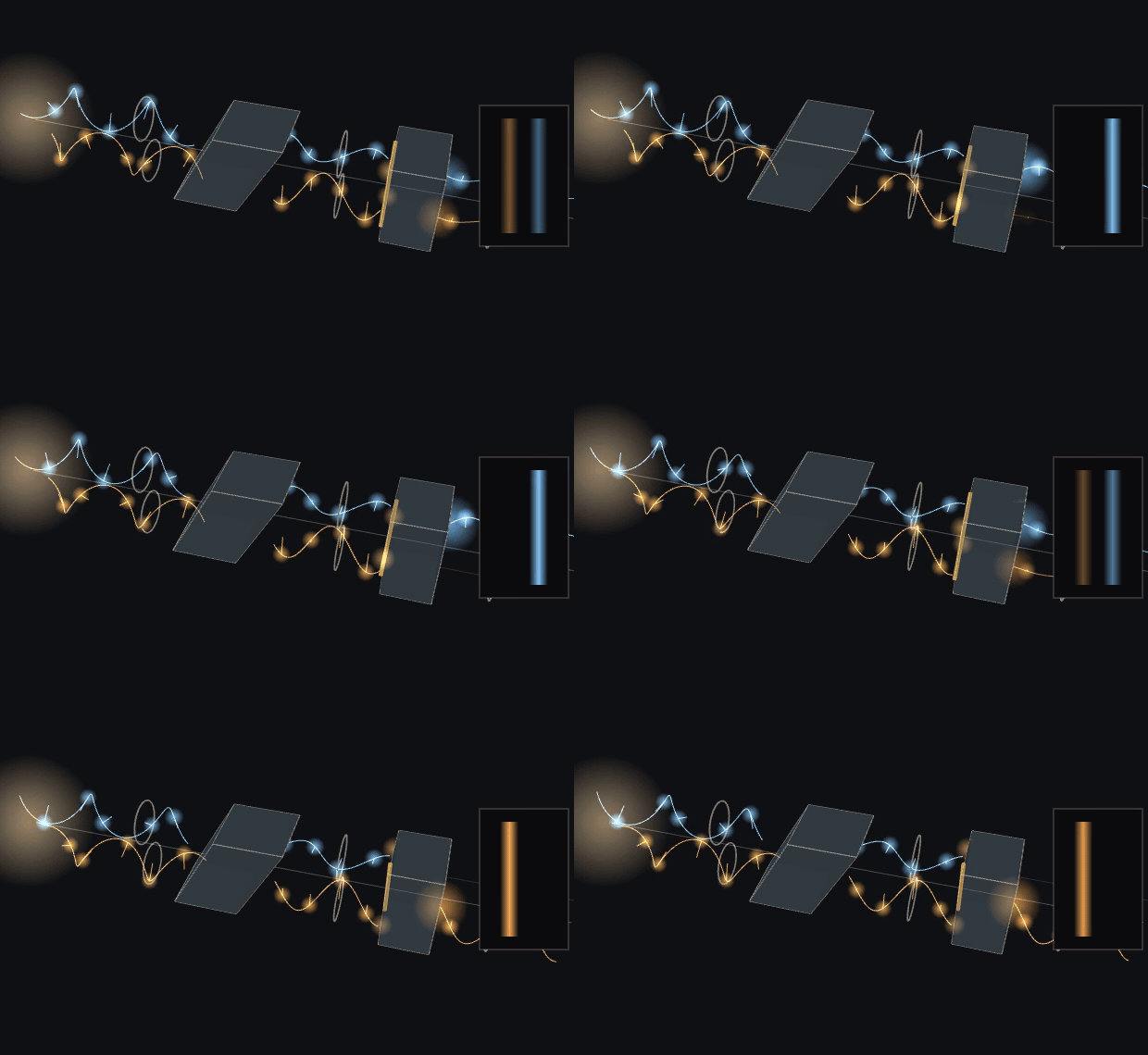
Figure 3. Hale’s method in 1908: the Fresnel rhomb turns circular polarization into linear polarization; with the Nicol prism turned to one angle, only one line of the sunspot doublet remains; turned through ninety degrees, only the other.
Hale wrote that the only known means of transforming a line into such a doublet was a strong magnetic field. From this he worked out that the magnetic field in sunspots was about 2900 gauss (this was computed from the iron lines; computed from the chromium lines it came out at 2600 gauss). The gauss is a unit of magnetic field; the field at the Earth’s surface is less than 1 gauss, and Zeeman’s electromagnet gave about ten thousand gauss. This is usually regarded as the first time humans measured a magnetic field beyond the Earth.
What the magnet did to the light
Lorentz’s idea was this: what gives out the light is a small charged particle inside the atom. It is held as if by a spring and vibrates back and forth, and the frequency of the vibration is the frequency of the light it gives out.
Any vibration can be split into three simple motions: one back and forth along the direction of the magnetic field, and two going round in the plane at right angles to the field, one clockwise and one counterclockwise.
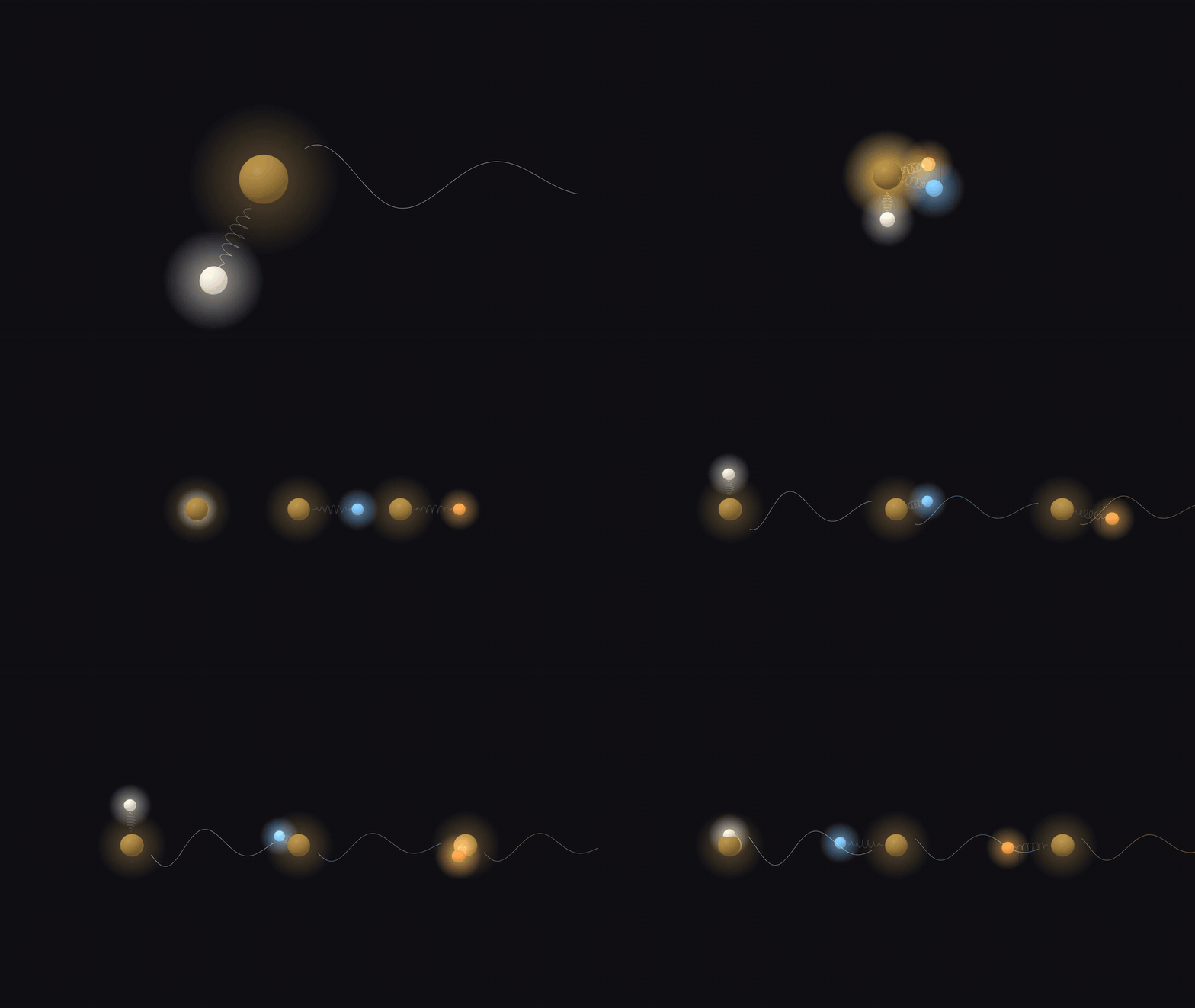
Figure 4. Any vibration can be split into three: one back and forth along the field, and two going round in the plane at right angles to the field, one clockwise and one counterclockwise.
Now add the magnetic field. A magnetic field exerts a force on a moving charged particle, always at right angles to the direction of motion. The motion back and forth along the field is not affected. Of the two circling motions, one is pulled inward by this force and goes round a little faster; the other is pushed outward and goes round a little slower.
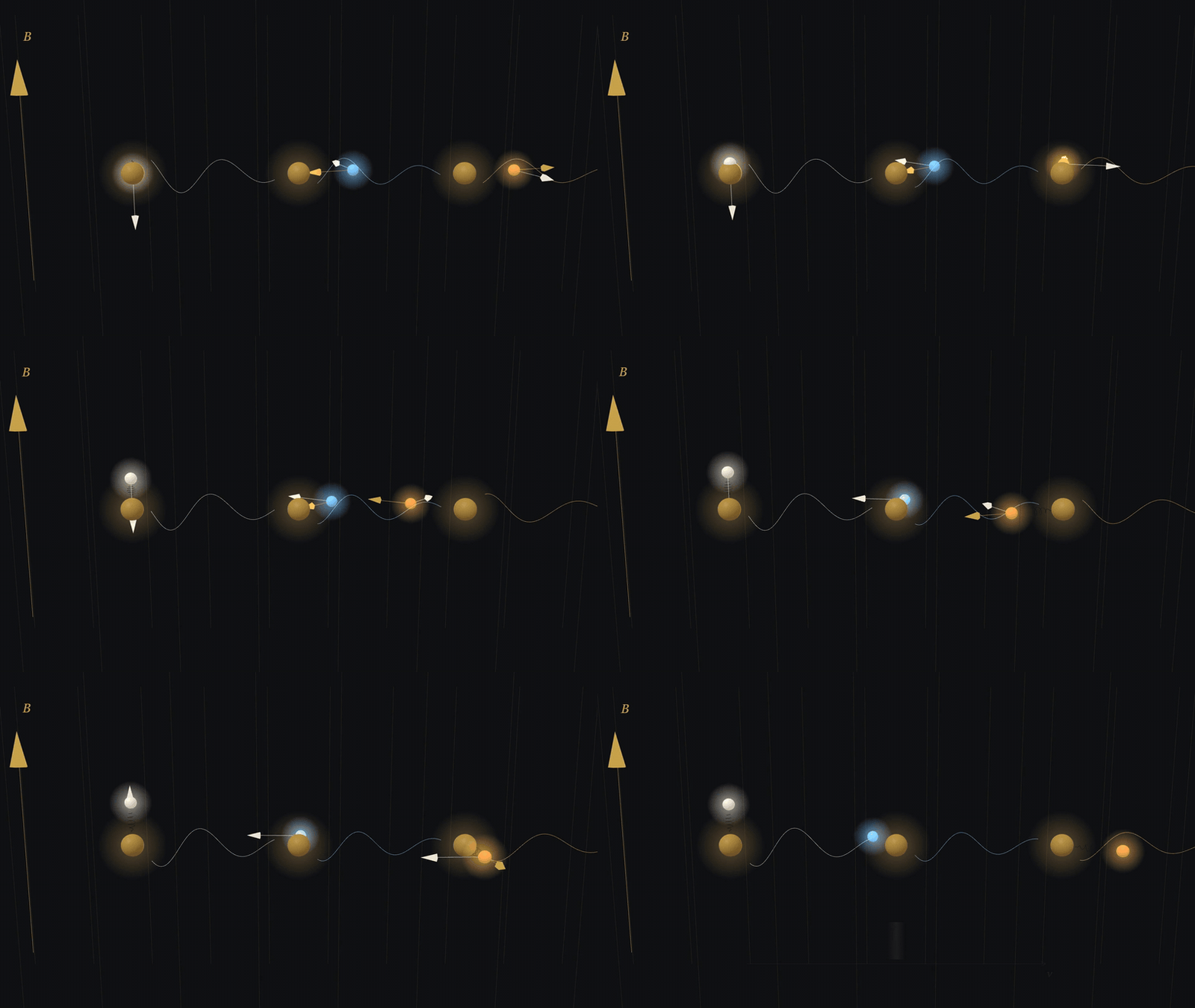
Figure 5. With the field on, one circling motion is pulled inward and goes round a little faster, the other is pushed outward and goes round a little slower.
So the one original frequency becomes three: the middle one unchanged, and one on each side, a little higher and a little lower. These are the three lines seen from the side.
If you look along the direction of the magnetic field, the vibration back and forth along your line of sight cannot send light into your eye, so the middle line disappears and only the two outer lines remain. And of these two, one turns to the left and one to the right. This is the circular polarization Lorentz predicted.
Why circular one way and linear the other? Looking along the field, the two circling motions are circles turning face on to you, and the light they give out has its direction of vibration turning round with them, so it is circularly polarized. From the side, you see only the edge of the same circle, and the circling looks like a motion back and forth along a straight line, so the three lines seen from the side are all linearly polarized.
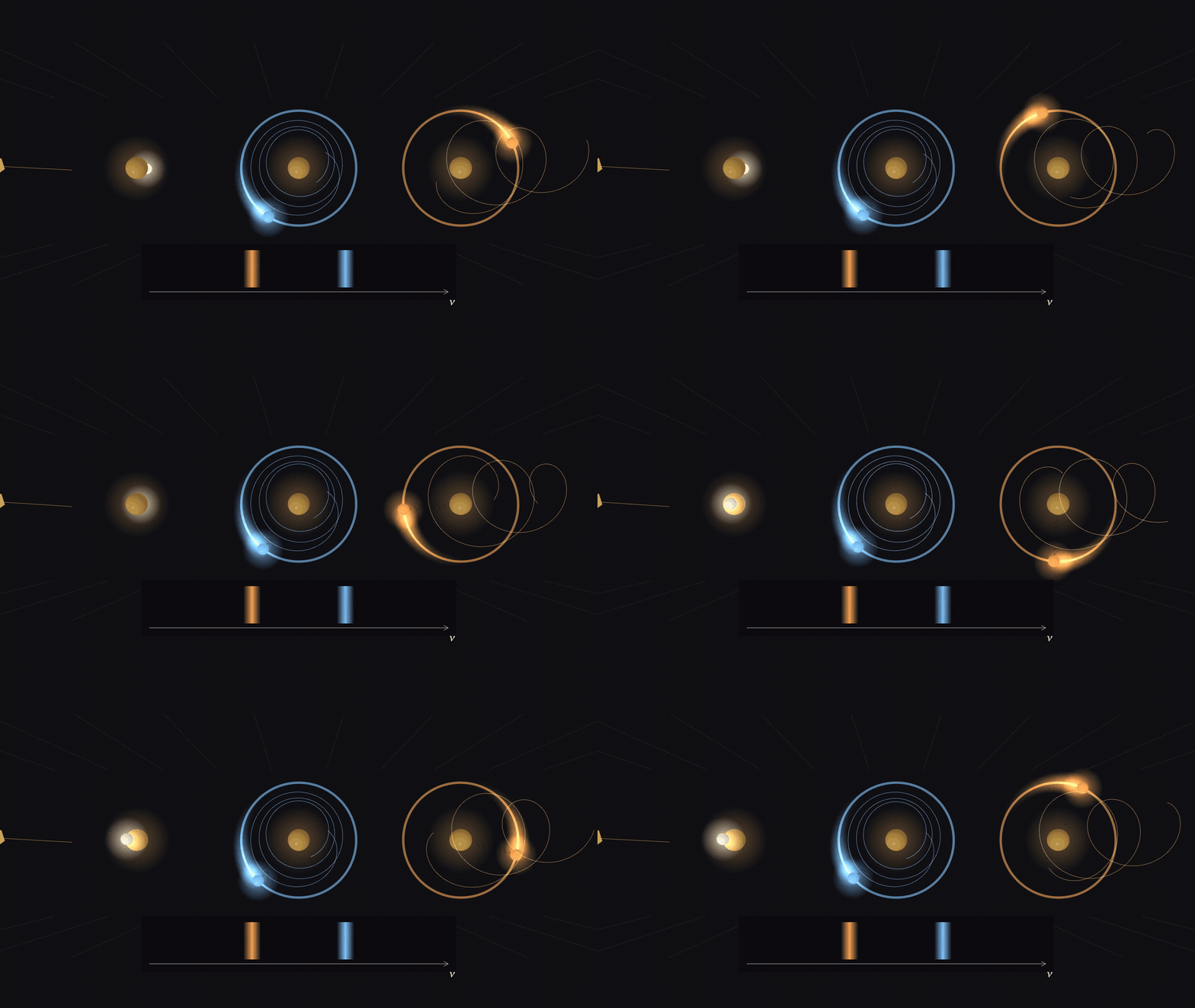
Figure 6. Looking along the field, the two circling motions face you, and the direction of vibration of the light they give out turns round with them: circular polarization.
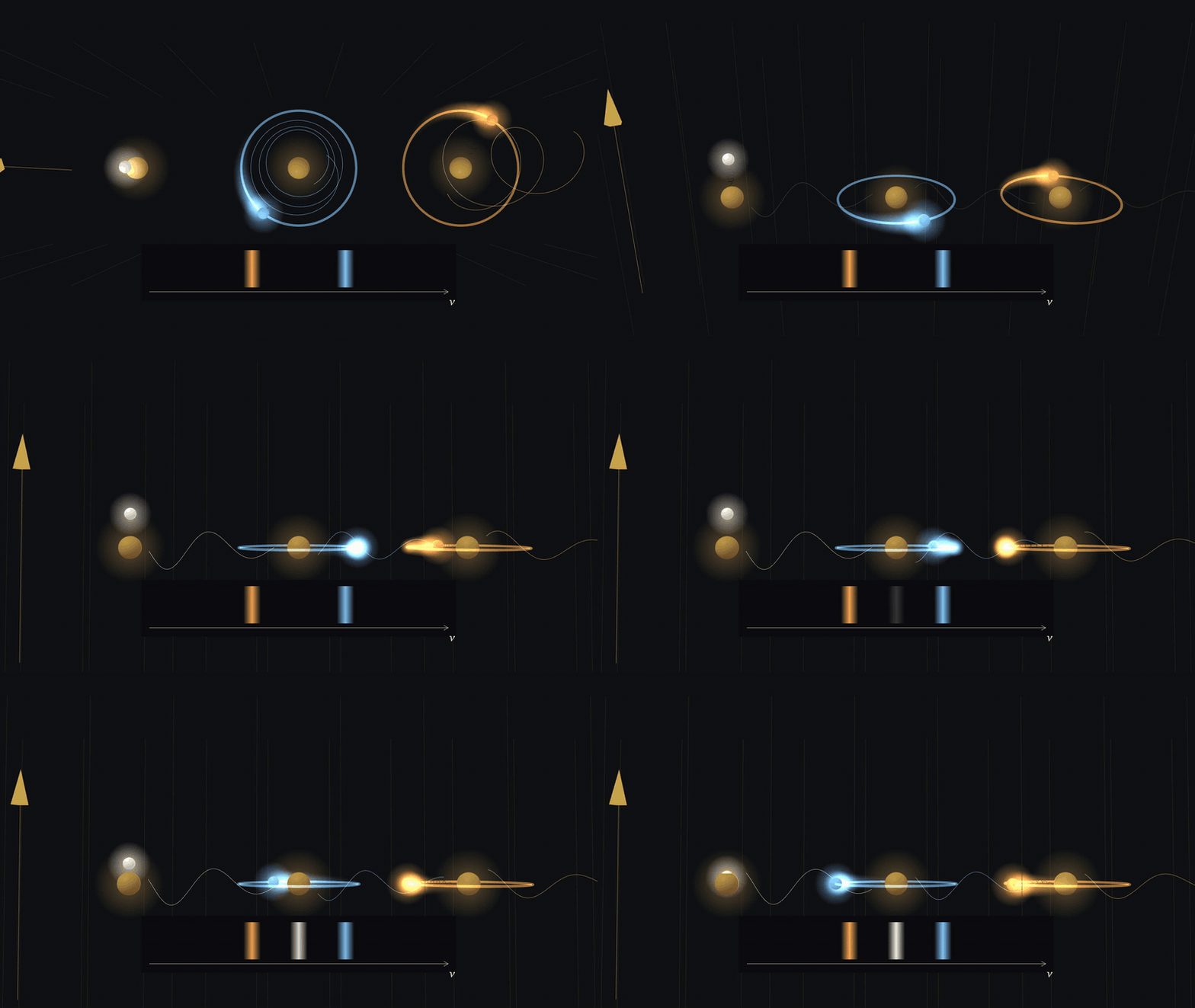
Figure 7. From the side, you see only the edge of the same circle, and the circling becomes a motion back and forth along a line: all three lines are linearly polarized.
More importantly, how far apart the two lines move depends on the particle’s ratio of charge to mass. Zeeman worked back from the size of the widening to this ratio, and in his paper of November 1896 wrote: “e/m is of the order of 10⁷” (translated), in the electromagnetic units of the time.
This number was astonishingly large. He said in his Nobel lecture that even for the physicist it was a colossal number, a thousand times as great as the ratio of charge to mass of the hydrogen ion. A hydrogen ion is a hydrogen atom that carries an electric charge. In other words, the thing vibrating inside the atom and giving out light is much lighter even than the lightest atom.
In 1897 the British physicist J. J. Thomson also measured this ratio in cathode rays, that is, the kind of rays traveling in Röntgen’s discharge tube in the last episode. In his paper of that year he wrote that this particle’s value, 10⁻⁷, is very small compared with the hydrogen ion’s 10⁻⁴ (what he computed was the ratio of mass to charge, exactly the inverse); in a lecture at the Royal Institution he made a point of mentioning that this was of the same order as what Zeeman had deduced from sodium light. This kind of particle is what we now call the electron.
A sign the wrong way round
There is one more small episode in this story. Which polarized line has the higher frequency can tell us whether the particle carries positive or negative charge. In Section 24 of his 1896 paper Zeeman wrote: what is moving is positively charged ions.
To tell which of the two lines turns left and which turns right, you need a thin crystal plate called a quarter-wave plate. It can turn circularly polarized light, which goes round, into linearly polarized light with a fixed direction, and left-handed and right-handed light come out in different directions, exactly 90 degrees apart. The plate has two directions on it, one called the fast axis and the other the slow axis; if they are marked the wrong way round, left and right are mistaken for each other, and positive and negative are judged the wrong way round as well.
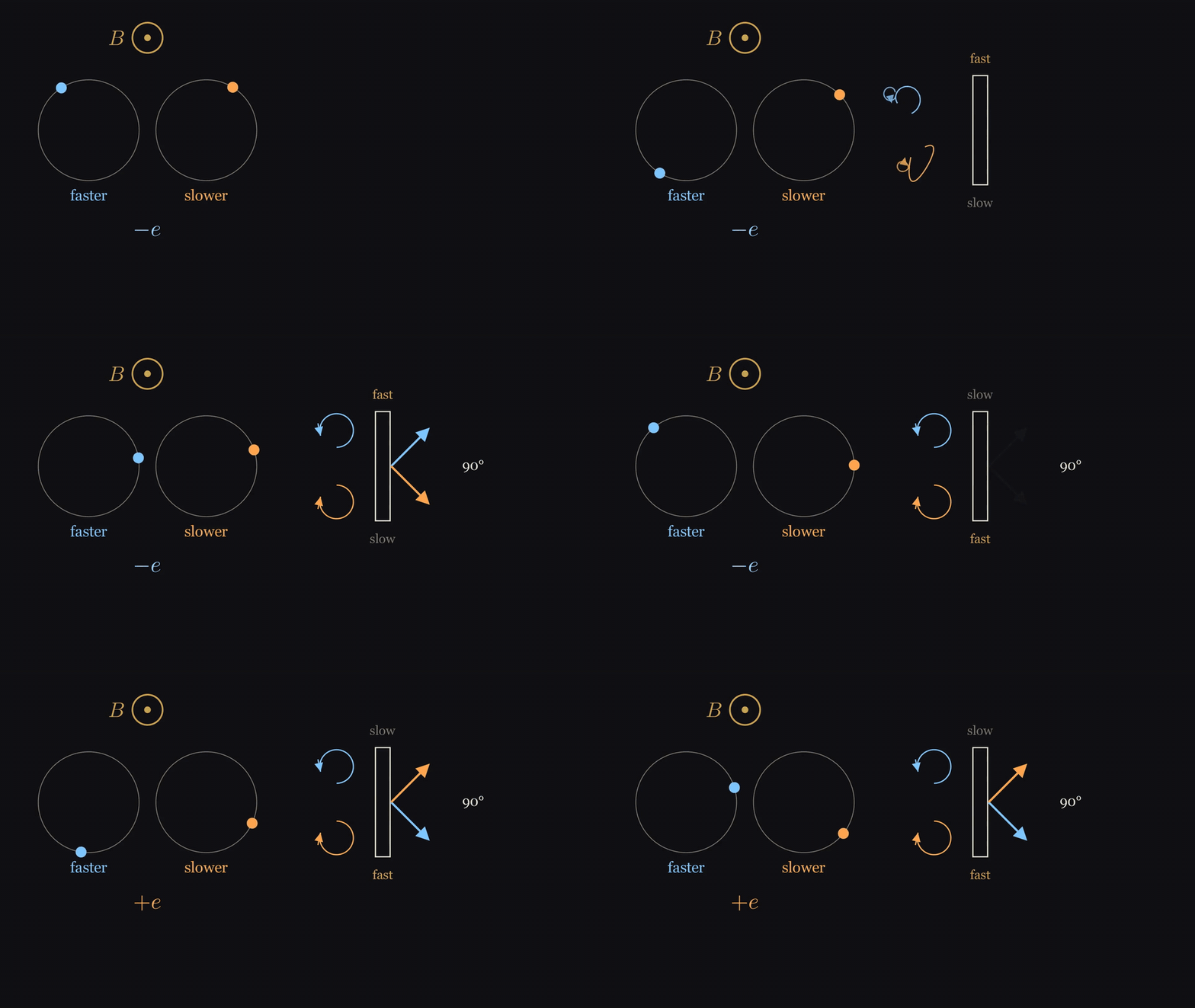
Figure 8. A quarter-wave plate turns the two circular polarizations into mutually perpendicular linear polarizations; with the fast and slow axes marked the wrong way round, the two lines swap, and positive and negative are judged the wrong way round as well.
In July 1897, in a footnote to a paper in the Philosophical Magazine, he corrected it: “Hence the radiation is due chiefly to the motion of a negatively-charged particle. Probably my mistake arose from a faulty indication of the axis of the λ/4-plate used.”
Nine years later Philipp Lenard, in his Nobel lecture, still went out of his way to note that in Zeeman’s first publications the word “positive” - not “negative” - was printed. This is the same Lenard from the last episode, the one who quarreled with Röntgen all his life.
Working it out from the start
Below, what was just said is derived again from the beginning with equations. The full derivation, including the exact solution, why the polarization is distributed as it is, and how the sign is determined, is in Appendix A.
With no magnetic field. The electron has mass and charge , and is held by a spring. The spring’s force is proportional to the displacement and opposite in direction:
Its solution is a vibration with angular frequency . Angular frequency is the number of radians turned through per second, equal to times the frequency. corresponds to the original spectral line.
Adding the magnetic field. Along the direction apply a magnetic field , and look at the two circling motions in the plane perpendicular to . Let the electron go round with angular velocity , at radius .
To make something go round in a circle, there must be a force always pointing to the center, called the centripetal force, of size . This centripetal force comes from two parts: the pull of the spring, , plus or minus the force of the magnetic field, that is, the Lorentz force, of size times the speed times , where the speed is . The Lorentz force is the force a magnetic field exerts on a moving charge: if the charge does not move, there is no such force; once the charge moves, the direction of the force is perpendicular both to the velocity and to the magnetic field, so here it lies exactly along the radius, pointing either toward the center or away from it. Whether it adds or subtracts depends on the direction of rotation:
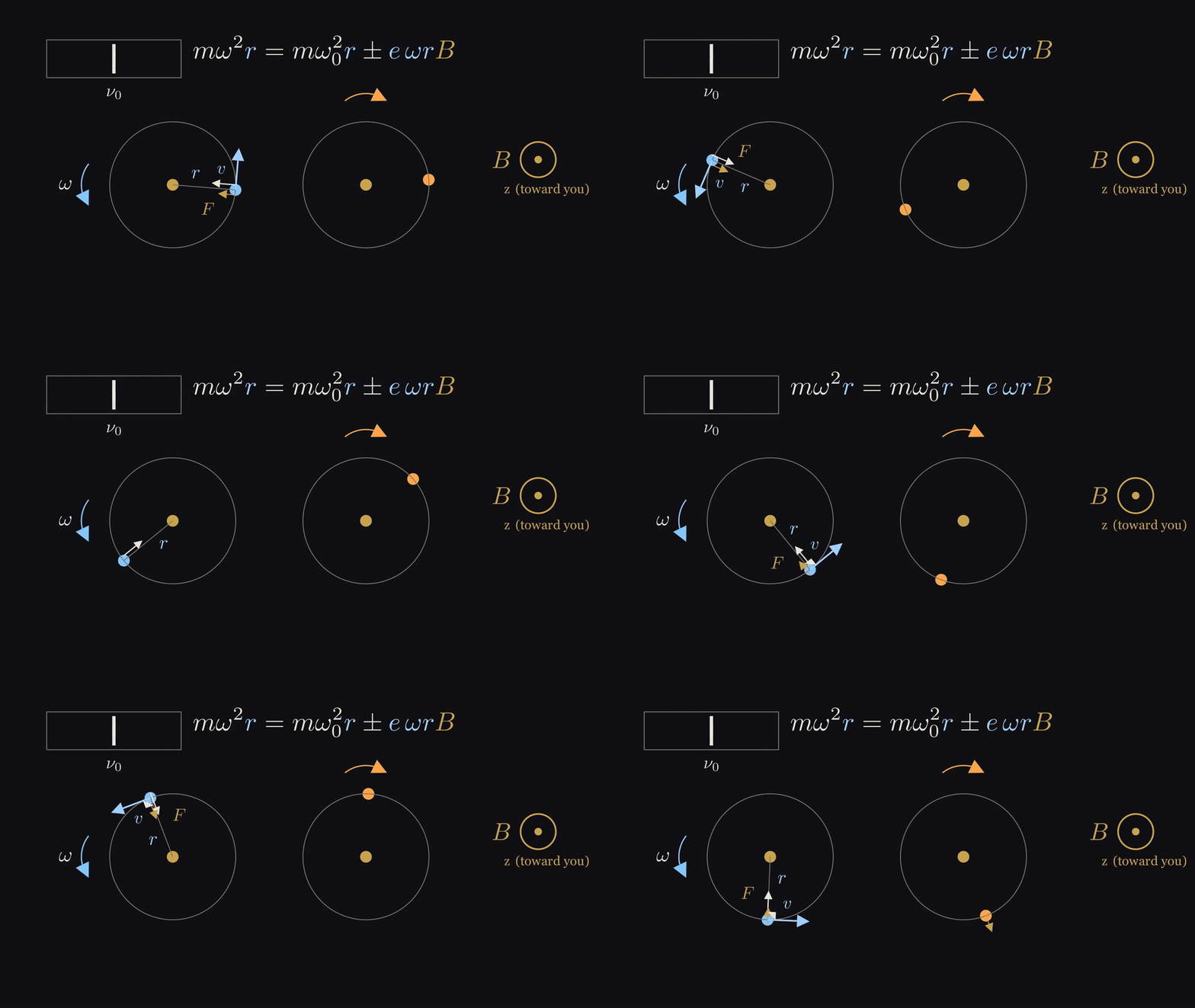
Figure 9. The Lorentz force: if the charge does not move, there is no such force; once the charge moves, the force is perpendicular both to the velocity and to the magnetic field, and here it lies exactly along the radius.
Cancel on both sides, and you get a quadratic equation in :
Its positive roots are
The term due to the magnetic field is much smaller than , so the second term under the square root can be neglected, and so
One goes round a little faster and one a little slower, and the difference depends only on , and , not on the spring. Converting to frequency by dividing by , each line moves by
This is the formula for the normal Zeeman effect.
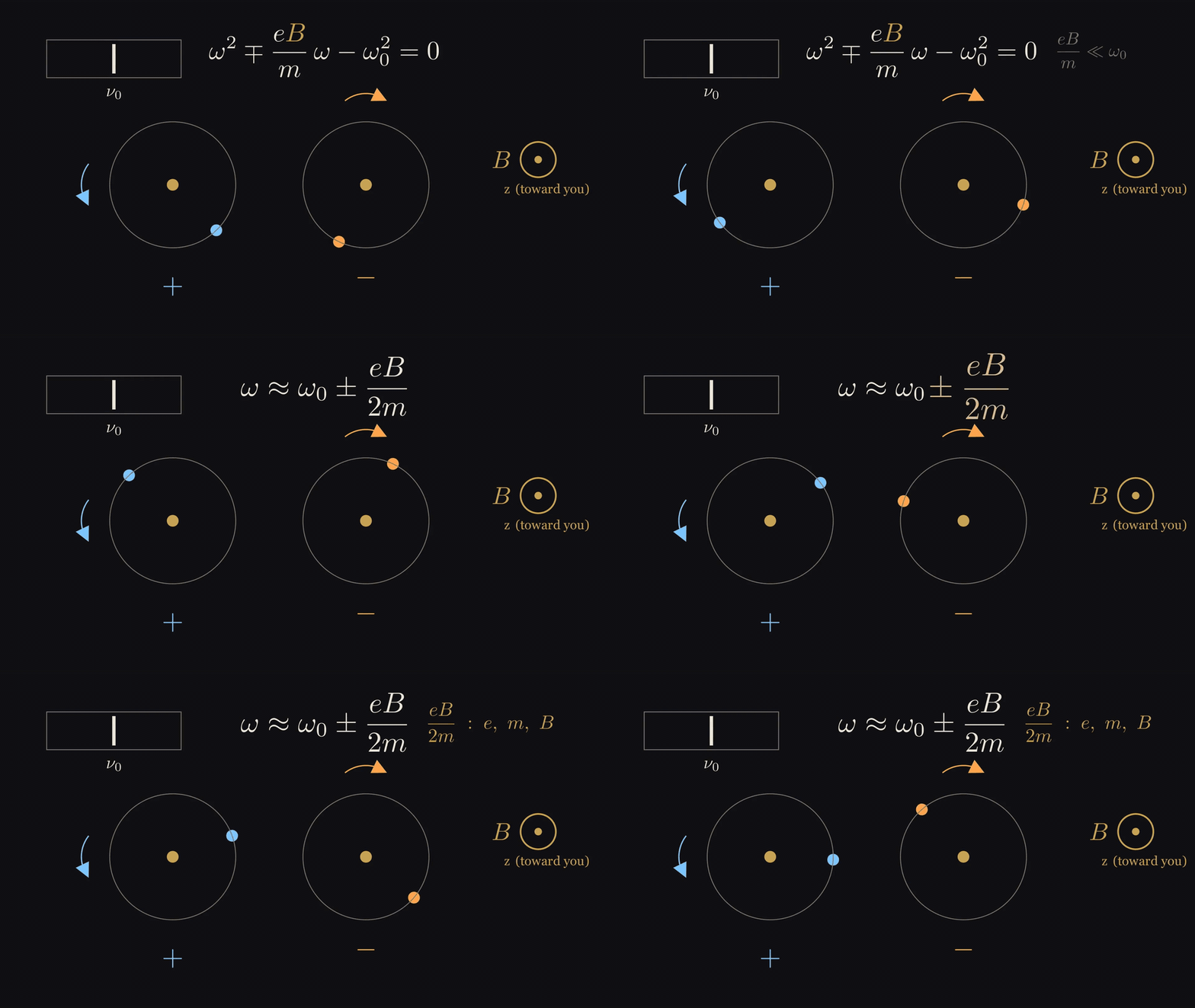
Figure 10. Solving gives ω ≈ ω₀ ± eB/2m: one goes round a little faster, one a little slower, and the difference depends only on e, m and B, not on the spring.
Putting in numbers. Zeeman wrote in 1897 that the field of his electromagnet was about “10⁴ C.G.S. units”, that is, about 1 tesla. The electron’s ratio of charge to mass is coulombs per kilogram. Substituting:
Converting to wavelength, . The yellow sodium line has a wavelength of 589 nanometers:
That is, 0.16 ångström (1 ångström is 0.1 nanometer). The two D lines themselves are 0.6 nanometers apart, and the shift caused by the magnetic field is about a fortieth of that. What Zeeman measured in 1897 was exactly a fortieth; later, in his Nobel lecture, he put it as “a thirtieth of the distance between the two sodium lines, say two tenths of an Angstrom”, which is of the same order.
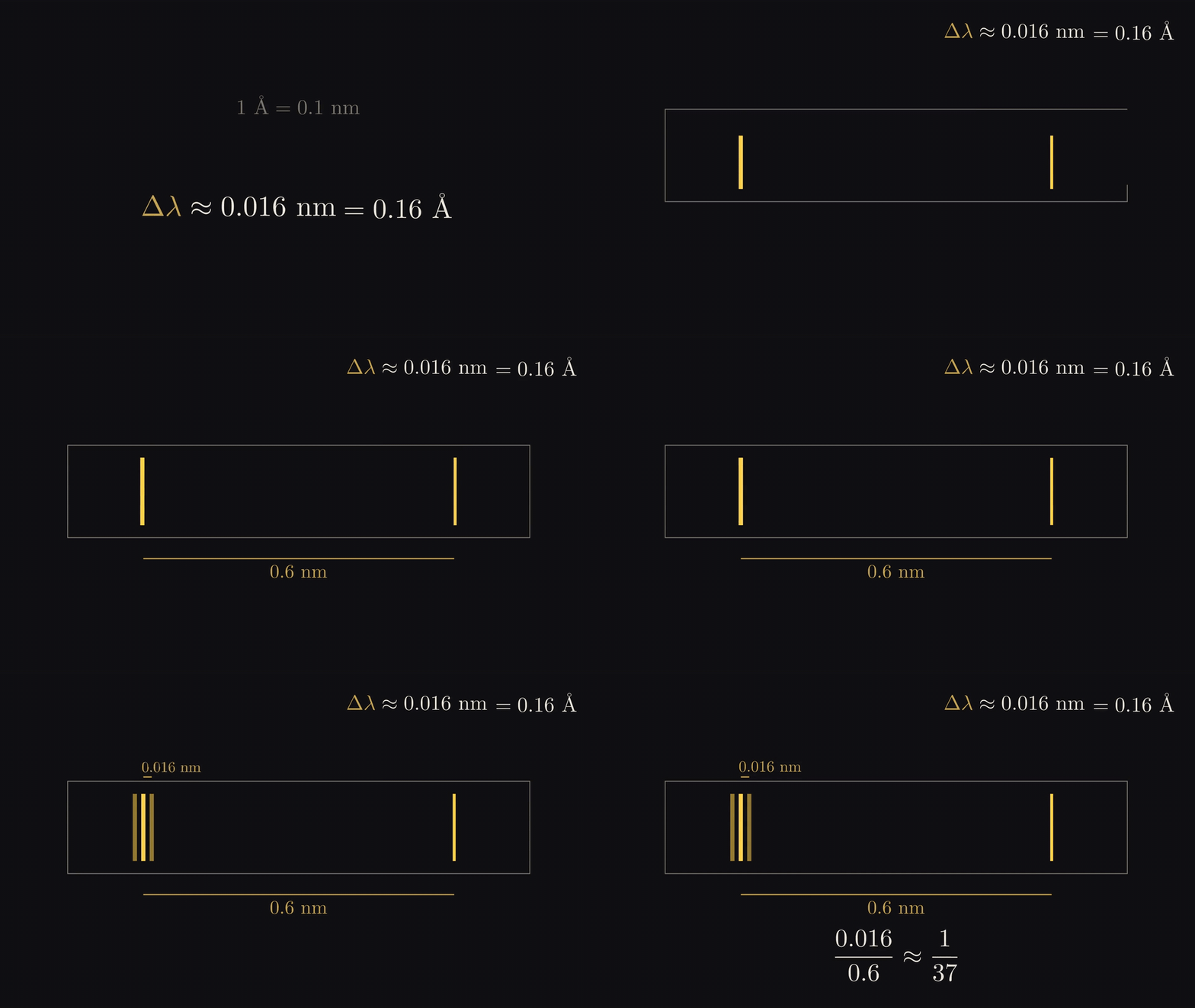
Figure 11. The two yellow sodium lines are 0.6 nanometers apart; the shift caused by a 1 tesla field is about 0.016 nanometers, about a fortieth of that.
Turning it round. Measure , and you can compute
This is how Zeeman, from the change in the spectral lines, made the first estimate of the electron’s ratio of charge to mass.
The sign. Which of the two directions of rotation has the higher frequency depends on the sign of the charge: when the magnetic field points toward you, the one you see turning counterclockwise has the higher frequency if the particle is negatively charged. To tell left-handed from right-handed, a quarter-wave plate must be used to turn circular polarization into linear; if the plate’s fast and slow axes are marked the wrong way round, the sign is judged the wrong way round. This is where the mistake of 1896 came from.
December 1902, Stockholm
In 1902 the Nobel Prize in Physics was awarded to two men, Lorentz and Zeeman, half each. The citation reads: “in recognition of the extraordinary service they rendered by their researches into the influence of magnetism upon radiation phenomena”. The original Swedish can be read on a photograph of Zeeman’s diploma; compared with Röntgen’s of 1901, it has one more word, “half” (hälften af).
In his presentation speech, Hjalmar Théel, President of the Royal Swedish Academy of Sciences, said that dividing this prize between these two outstanding researchers was not only justified, but just.
December 10, Stockholm. Zeeman was ill and could not come. So Lorentz received the prize from the King’s hands. At the banquet he spoke in German, saying that Zeeman’s not being able to share this honor with him was the only thing that clouded this fine day.
The next day Lorentz gave his Nobel lecture, titled “The Theory of Electrons and the Propagation of Light”. Coming to the experiment, he said: “imagine that my hands are the two poles, only much closer together than I am holding them now, and that the light source is between these poles.”
Zeeman’s Nobel lecture was postponed to May 2 of the following year, titled “Light Radiation in a Magnetic Field”. Coming to how small the change in the lines is, he said it was about two tenths of an ångström, and went on: “a unit of measure whose name will always recall to physicists the meritorious work done by the father of my esteemed colleague.” The ångström unit is named after the Swedish physicist Anders Ångström.
He had also brought a model. Coming to the polarization, he said: “I will rotate the model so that the arrow points in your direction.” A note at the foot of the lecture text records that a number of lantern slides were projected in the course of the lecture.
What the archive says
The Nobel nomination archive is now public. For the 1902 Physics Prize there were 29 nominations in all.
Lorentz received 10 nominations, and his nominators included Henri Poincaré, Max Planck, and the previous year’s laureate, Röntgen. Zeeman had only 1; the person who nominated him was Svante Arrhenius, whom the archive notes as a member of the Nobel Committee for Physics.
Not a single nomination put the two of them together. Why it was finally decided that the two should share the prize, the public pages of the archive do not say.
Several others nominated this year also won the prize later: Becquerel and Curie (1903), Rayleigh (1904), Lenard (1905), Thomson (1906), Marconi (1909), Guillaume (1920). Arrhenius himself was also nominated for the Physics Prize; the following year he won the Chemistry Prize.
There was one more man very close to this subject: the Scot John Kerr. He discovered that light reflected from the polished face of a magnet’s pole has its polarization changed, the very effect measured in Zeeman’s doctoral thesis. Lorentz also mentioned him in his lecture. Lord Kelvin nominated him. Yet Kerr never received a Nobel Prize in his lifetime.
A story also circulates online: Zeeman disobeyed his supervisor’s orders, used the laboratory’s equipment for the experiment, and was dismissed from the university for it.
The earliest source we can find is an edit made by an anonymous user on English Wikipedia on April 3, 2009. The version before this edit has no “disobeyed”, no “fired”, and no “supervisor”. The same edit also gave the year of his prize as 1908.
The records of the time say exactly the opposite: his paper was presented to the Academy on his behalf by none other than his supervisor, Onnes. In his 1897 paper he thanked Onnes for his continuous interest in this subject. He left Leiden because the University of Amsterdam invited him to become a lecturer.
Two other common statements are not accurate either. One is “Lorentz predicted the Zeeman effect”. In fact Zeeman saw it first, and Lorentz then explained it, and predicted the polarization. Lorentz himself also said in his Nobel lecture that when Zeeman made his discovery, the electron theory was complete in its main features and in a position to interpret the new phenomenon. The other is “in 1896 Zeeman saw the sodium lines split”, which some Chinese textbooks and lecture notes still say. In 1896 what he saw was only a widening; he first really saw lines separate in 1897, with the cadmium line.
Prize money
The prize money for 1902 was 141,847 Swedish kronor, 94% of the previous year’s. The two each received half, about seventy thousand kronor each.
Afterwards
The four lines Cornu saw were later given a name: the anomalous Zeeman effect. Lorentz’s theory could not explain it. In the autumn of 1922 the young Wolfgang Pauli went to Copenhagen at Bohr’s invitation, hoping to solve this problem, and came away feeling that it was even more unapproachable.
The answer appeared in 1925. Two young Dutchmen, George Uhlenbeck and Samuel Goudsmit, proposed that the electron itself is also spinning, what we now call spin. Their short paper is signed “Leiden, den 17. Oktober 1925”, the very place where Zeeman had made his discovery. Pauli later said in his Nobel lecture: “The gap was filled by Uhlenbeck and Goudsmit’s idea of electron spin.”
In 1923 Amsterdam built a new laboratory specially for Zeeman. Inside it was a concrete block of 250,000 kilograms, whose foundations were laid separately from those of the rest of the building, so that experiments would not be disturbed by vibration. For the sake of magnetic experiments, no steel or iron was used in building it.
Lorentz later went to Haarlem, where he directed the laboratory of Teylers Museum, and he also chaired the first five Solvay conferences. The Solvay conferences were funded by the Belgian chemist and soda industrialist Ernest Solvay, and the idea came from the physicist Walther Nernst. The first, in 1911, was a private meeting to which only eighteen scientists were invited, to discuss the most disputed question of the day: radiation and the quanta.
Today many people know his name because of the Lorentz transformation. In 1904 Lorentz wrote down this set of equations. The next year Poincaré named it after him, calling it the Lorentz transformation, and also fixed one of its coefficients at 1. In the same year Einstein also derived the same set of equations in special relativity.
On February 4, 1928, Lorentz died in Haarlem, aged 74. At noon on February 9, the day of his burial, telegraph traffic across the whole of the Netherlands stopped for three minutes, from 12:00 to 12:03; even wireless telegraphy and ships’ radio stopped, with only distress signals allowed. At his grave Einstein said that he never wished to dominate, only always to serve.
Zeeman retired in 1935 and died in Amsterdam in October 1943, aged 78. He and Lorentz are buried in the same cemetery in Haarlem.
Today NASA’s Solar Dynamics Observatory makes maps of the Sun’s magnetic field every day. What it relies on is still the Zeeman effect: by measuring the changes of a spectral line in circularly polarized light, the strength of the magnetic field along the line of sight can be calculated. This is the same thing Hale saw in sunspots in 1908.
In the laboratory, physicists use lasers to cool atoms to close to absolute zero. One of the key devices is called a Zeeman slower: a beam of atoms flies into a laser beam, which keeps slowing them down; as the atoms slow down, their speed into the laser changes, and the color of the laser light they perceive changes with it, which is called the Doppler effect; the slower uses a magnetic field whose strength changes along the way to shift, through the Zeeman effect, the color the atoms absorb back into step, so that the laser can keep pushing on them.
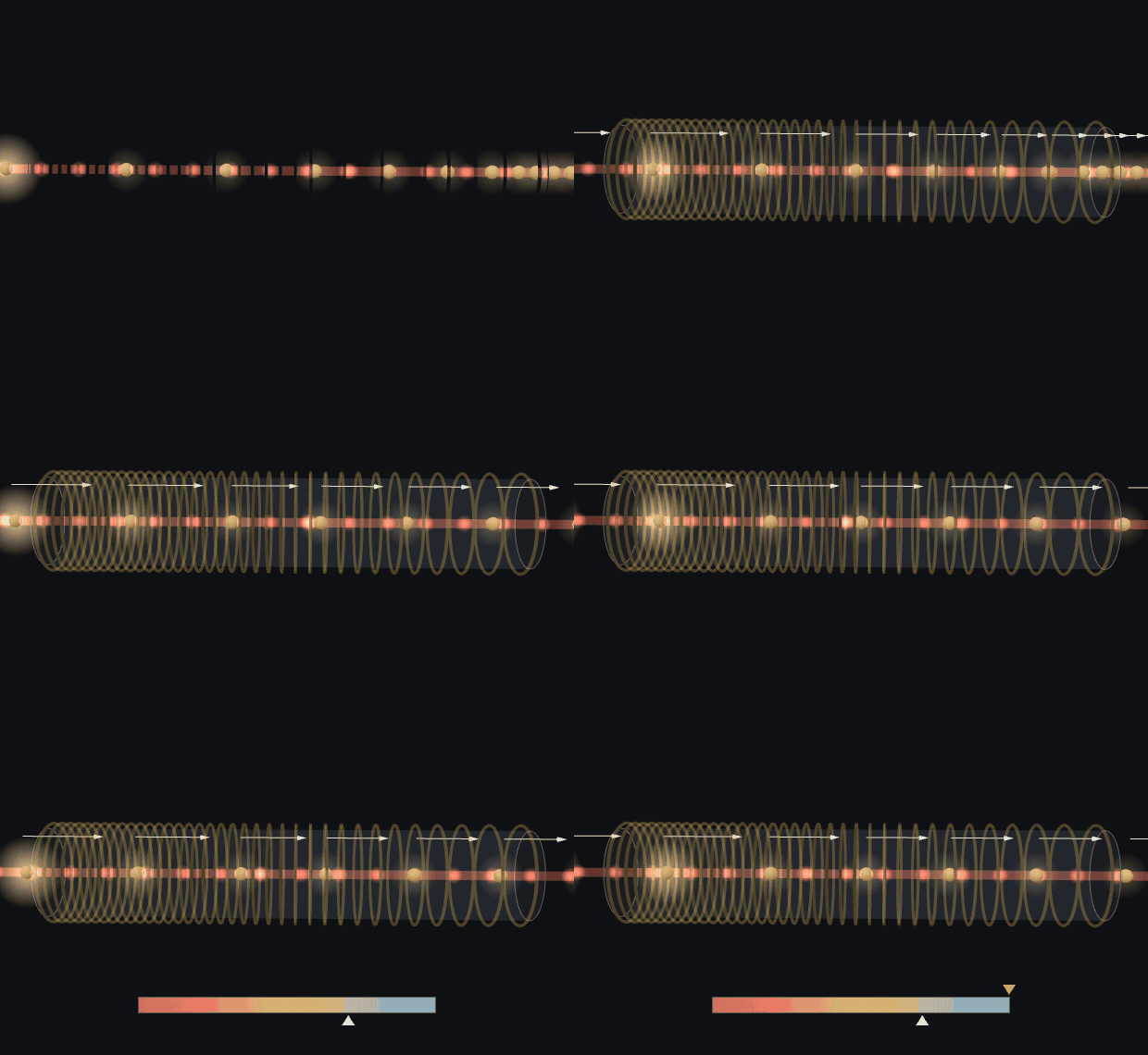
Figure 12. Zeeman slower: atoms fly into the laser and slow down along the way; the slower uses a magnetic field whose strength changes along the way to shift, through the Zeeman effect, the color the atoms absorb back into step, so that the laser can keep pushing on them.
A flame sprinkled with salt, an electromagnet, a yellow line that widened. From here we learned that there are electrons in atoms, and later that electrons spin.
The next episode is 1903, Henri Becquerel and Pierre Curie, Marie Curie: a substance that gives off rays by itself.
Appendix A: Physics derivations
The three sections of the main text, “What the magnet did to the light”, “A sign the wrong way round” and “Working it out from the start”, told one main line: an electron on a spring, three motions, , , 0.016 nanometers. This appendix derives this line again from the beginning, and then adds four things the main text did not develop: the exact solution of the equation and why the three motions are “all” of them; why the middle line cannot be seen looking along the magnetic field; how Zeeman himself computed from the widening; and why marking a quarter-wave plate the wrong way round leads to judging the sign the wrong way round. Each result is followed by an example you can compute yourself. The constants are taken from NIST’s CODATA 2018, the wavelengths of the sodium D lines from the NIST Atomic Spectra Database, and Zeeman’s numbers from his two papers published in the Philosophical Magazine in 1897 and his Nobel lecture of 1903.
Notation in this appendix
| Symbol | Meaning |
|---|---|
| magnitude of the electron charge, coulomb | |
| electron mass, coulombs per kilogram | |
| the particle’s charge, with sign; for the electron | |
| , , | the particle’s displacement from its equilibrium position, its velocity, its acceleration |
| , | magnetic field, taken along the axis, of magnitude , in tesla; 1 tesla gauss |
| the magnetic field in Zeeman’s papers, in electromagnetic CGS units, numerically equal to the number of gauss | |
| angular frequency of the spring oscillator without a magnetic field, | |
| , called the Larmor frequency | |
| angular velocity of the circular motion, with sign: positive for counterclockwise, negative for clockwise (see the convention in A.1) | |
| , , | frequency, wavelength and period of the light, , |
| , | frequency shift and wavelength shift caused by the magnetic field (one side) |
| angle between the line of sight and the magnetic field | |
| emu | unit of charge in electromagnetic CGS, 1 emu coulombs |
| Bohr magneton, GHz per tesla | |
| Landé factor (used only in A.5) |
Convention on direction. When this appendix says “counterclockwise” or “clockwise”, it always means the direction of rotation seen by an observer when the magnetic field points toward that observer. Zeeman’s 1897 paper uses the same convention (§18: “for an observer standing on the side to which the lines of force point” (translated)).
A.1 An electron on a spring
Definition A1.1 (Lorentz’s model). A particle of mass and charge is subject to a spring force that pulls it back to its equilibrium position, and is placed in a uniform magnetic field along the axis, . Its equation of motion is
The second term is the force of the magnetic field on a moving charge, called the Lorentz force. It is perpendicular both to the velocity and to the magnetic field, so it does no work and only changes the direction of motion.
Proposition A1.2 (the component along the field is unaffected). The component of (A1.1) is , and its frequency is still .
Proof. has no component, so in the direction only the spring force remains. (QED)
This is the middle line that does not move.
Proposition A1.3 (two circular motions in the plane). Let . In the plane perpendicular to the magnetic field, (A1.1) becomes
It has two circular solutions , where is the signed angular velocity, given by
For the electron ():
The counterclockwise branch turns faster and the clockwise branch slower, and their angular velocities differ by exactly . For a positive charge it is the other way round: clockwise fast, counterclockwise slow.
Proof. The and components of the Lorentz force are ; combined into a complex number: , and dividing by gives (A1.2). Substituting , , , gives , which is the quadratic equation of (A1.3); its two roots have opposite signs. When the argument of increases with time, which, seen looking back from the side (the side the magnetic field points to), is counterclockwise. Taking , , the positive root is and the magnitude of the negative root is ; subtracting gives . Changing to , the magnitudes of the two roots are exchanged. (QED)
Remark A1.4 (why there are only these three). (A1.1) is a linear equation, and the general solution for the three components is
with two real constants and and two complex constants and , six real constants in all, corresponding exactly to the six initial conditions (three positions, three velocities). So any motion of the particle is “a straight-line vibration along the field” plus “two circles in opposite directions”, and nothing else. This is what the main text means by “any vibration can be split into three”. In §18 of his 1897 paper Zeeman mentions that the general solution also contains “slowly rotating elliptical orbits” (translated): an ellipse is the superposition of two circles in opposite directions; without a magnetic field the two circles turn equally fast and the ellipse stays still; with a magnetic field, one circle turns faster and one slower, and the major axis of the ellipse slowly rotates with angular velocity . This is the content of Larmor’s theorem.
Proposition A1.5 (first-order approximation). Expanding the square root,
To first order this is the main text’s . The second-order term is the same for both branches and does not change the spacing between the two branches.
Proof. , substituted into (A1.4). (QED)
The shift contains only and , and no : for any spectral line, as long as it can be described by this model, the frequency shift is the same, whatever the stiffness of the spring.
Example A1.6. Take tesla and the yellow sodium line, nanometers. radians per second, radians per second, and their ratio is . The exact roots and the first-order approximation differ only by radians per second, which, relative to , is , far beyond the resolving power of any spectrometer. The angular velocities of the two branches differ by radians per second. I also checked these roots by another route: integrating (A1.1) numerically over 40 periods and measuring the angle turned through, which agreed with the two roots of (A1.4) to one part in a million; with the magnetic field set to zero, both directions return to .
A.2 Which direction you look from
Citation A2.1 (the radiation field far away). For a charge moving with acceleration at a speed much less than the speed of light, the electric field at a distance from it is
where is the projection of the acceleration onto the plane perpendicular to the line of sight. It is not derived here; see Feynman, The Feynman Lectures on Physics, Volume I, Chapter 28, equation (28.6). Two points matter: only the part of the acceleration perpendicular to the line of sight gives out light; the direction of the electric field is the direction of this part of the acceleration. If a charge moves back and forth straight toward you, you do not see its light.
Proposition A2.2 (what light each of the three motions gives out). Let the magnetic field be along .
- Straight-line vibration along the field: looking along the field () it gives out no light; seen from the side (), the electric field is along , and the light is linearly polarized, vibrating parallel to the magnetic field; in a general direction the intensity is proportional to .
- Circular motion: looking along the field, the electric field turns round in the plane of view, and the light is circularly polarized, turning in the same direction as the particle; seen from the side, only the component of the electric field perpendicular to the magnetic field remains, and the light is linearly polarized, vibrating perpendicular to the magnetic field, with half the intensity seen looking along the field.
Proof. 1. The acceleration is . With the line of sight along , . With the line of sight along , , and the electric field is along . When the angle between the line of sight and the axis is , , and the intensity is proportional to . 2. The acceleration of circular motion points to the center, , constant in magnitude, with its direction turning with the particle. With the line of sight along , the whole of lies in the plane of view, and turns with it, in the same direction as the particle. With the line of sight along , only remains, and the electric field is along , perpendicular to the magnetic field; the time average of is half of . (QED)
Example A2.3 (the brightness of the three lines). Suppose that without a magnetic field the particle’s vibration is equally distributed over all directions, so that the three motions each get the same energy. By Proposition A2.2, seen from the side the intensities of the three lines are in the ratio (side : middle : side); looking along the field, the middle line is 0, and each side line is twice what it is when seen from the side. The total amount of light received in the two directions is the same, consistent with the premise “equally distributed over all directions”. In §22 of his 1897 paper Zeeman saw from the side that the two edges of the widened line were plane-polarized light, and in §20, looking along the field, that the two edges were circularly polarized light of opposite senses, the same as the conclusions here.
Remark A2.4. This is why there are three lines seen from the side and only two looking along the magnetic field: the vibration of the middle line points straight at you and, by (A2.1), gives out no light. The two photographs of cadmium lines shown in Zeeman’s lecture, one a triplet and one a doublet, were taken looking in exactly these two directions.
A.3 The numbers
Proposition A3.1 (the shift). To first order, the frequency shift and wavelength shift of each outer line relative to the original line are
Conversely,
Proof. The first formula is (A1.5) divided by . The second: , . (A3.2) is the first formula solved for . (QED)
Example A3.2 (sodium D lines, 1 tesla). The wavelengths of the sodium D lines given by the NIST Atomic Spectra Database: the D2 line 588.995 nanometers, the D1 line 589.592 nanometers, 0.597 nanometers apart. At tesla, GHz. Substituting into (A3.1), the D2 line shifts by 0.01620 nanometers on each side and the D1 line by 0.01623 nanometers, both 0.162 ångström (1 ångström nanometer). The one-sided shift is of the spacing of the two D lines; after splitting, the two outermost lines are 0.032 nanometers apart, of the spacing.
Zeeman’s own reported numbers: §14 of his 1897 paper says that with a magnetic field of “about C.G.S. units” the sodium lines widened on each side by “about ” of the D-line spacing, i.e. 0.015 nanometers; the 1903 lecture puts it as “a thirtieth of the distance between the two sodium lines, say two tenths of an Angstrom”, i.e. 0.020 nanometers. The three numbers 0.015, 0.016 and 0.020 are of the same order, and in his paper he called this measurement “a first, approximate measurement” (translated). It should also be said that the sodium D lines do not split strictly according to this model (see A.5), and what he measured was the total width of a blurred line, so this comparison holds only as far as the order of magnitude. C.G.S. units is gauss, exactly 1 tesla.
Example A3.3 (the units he used). §23 of Zeeman’s paper says that is “of the order of magnitude electromagnetic C.G.S. units”, and the lecture says ” c.g.s. units per gram”. Converting to today’s units: the electromagnetic unit of charge is 1 emu coulombs, and 1 gram kilograms, so
Today’s value coulombs per kilogram is emu per gram. The same number is in the International System of Units and in his units. The of the hydrogen ion in electrolysis is coulombs per kilogram, and the electron’s is 1836 times larger; Zeeman’s “1,000 times” is taken as an order of magnitude.
Example A3.4 (Zeeman’s own back-calculation). Equation (6) in §18 of his paper is
where is the period. This is exactly the first-order result of (A1.5): , except that his is in electromagnetic units and in gauss. The numbers he substituted (paper p.230): the widening is of the D-line spacing, and the periods of the two D lines differ by one part in a thousand, so the relative change in the period is ; ; seconds. So
which is indeed “of the order of magnitude ”, and only 9% below today’s value. For a measurement he himself called preliminary, this is quite accurate.
Example A3.5 (Thomson). Thomson’s paper of October 1897 (Philosophical Magazine, volume 44) measured for the particles of cathode rays by two methods: the table on page 306 gives to , and the table on page 310 gives to , likewise in electromagnetic units. His conclusion was that the value of is independent of the nature of the gas, and that its value, , is very small compared with , the smallest value previously known, that of the hydrogen ion in electrolysis. Turned upside down, lies between and emu per gram, of the same order as the Zeeman obtained from spectral lines. Two entirely unrelated experiments, one looking at the light of a flame, the other at rays in a vacuum tube, measured the same number: what flies in cathode rays and what gives out light in atoms are the same kind of particle.
A.4 The sign
Proposition A4.1 (the sense of rotation determines the sign). The magnetic field points toward the observer. If the circularly polarized line of higher frequency turns counterclockwise, the particle giving out the light is negatively charged; if it turns clockwise, it is positively charged.
Proof. By Proposition A1.3, the electron’s counterclockwise branch is faster; by item 2 of Proposition A2.2, looking along the magnetic field, the electric field of the light turns in the same direction as the particle. So of the two circularly polarized lines given out by an electron, the counterclockwise one has the higher frequency. For a positive charge it is the reverse, by (A1.3). (QED)
§18 of Zeeman’s 1897 paper is written for positive ions: “if the rotation is in the positive direction (for an observer standing on the side to which the lines of force point, that is, clockwise), the period is slightly shorter” (translated), consistent with this. In §24 he concluded from experiment that “the positive ions revolve”; his paper of July of the same year (Philosophical Magazine, volume 44, page 58) corrected this in a footnote: “the radiation is due chiefly to the motion of a negatively-charged particle. Probably my mistake arose from a faulty indication of the axis of the λ/4-plate used”. The experimental statements in the two places are exactly opposite: in March he said that, looking along the lines of force, right-handed light has the shorter period; in July, that right-handed light has the longer period. What was corrected was the reading, not the theory.
Proposition A4.2 (the quarter-wave plate). A quarter-wave plate has two mutually perpendicular axes, the fast axis and the slow axis; light vibrating along the slow axis lags behind light vibrating along the fast axis by a quarter of a wavelength. A beam of circularly polarized light passing through it becomes linearly polarized light, vibrating along a line at 45° to the two axes; the two circular polarizations, counterclockwise and clockwise, come out as linear polarizations in mutually perpendicular directions. Exchanging the labels of the fast and slow axes exactly swaps the two outputs.
Proof. Use Jones matrices. Take the fast axis as and the slow axis as ; the plate is (the component lags by 90°). Writing the two circular polarizations as , passing through the plate gives : both are linearly polarized, in the directions and respectively, perpendicular to each other. Place a Nicol prism at the output (it lets through linearly polarized light in one direction only); turned to it passes one circular polarization and blocks the other, and turned through 90° it does the reverse. Exchanging the labels of the two axes amounts to using in the calculation, and the output becomes : what came out at now comes out at . (QED)
§20 of Zeeman’s 1897 paper describes exactly this experiment: with the plate and the Nicol set to the position where the right-handed light is extinguished, one edge of the widened line could no longer be seen; turning the Nicol through 90°, the other edge could not be seen; reversing the current in the electromagnet, the visible edge also switched. §21 says that, with the plate fixed and the Nicol rotated, the line in one full turn “twice widened and twice narrowed” (translated).
Remark A4.3 (why this mistake could stay hidden). The two tests in §20, turning the Nicol and reversing the current, show only that the circular polarizations on the two edges of the line are opposite in sense; they make no demands on the labels: with the labels stuck on the wrong way round, these two tests pass just the same. To know which edge is counterclockwise there is only one way, which is to trust the marking of the fast and slow axes on the plate. In the whole paper, only the one conclusion “positive ions” rests on the label of a piece of glass, and the other conclusions are not affected by it; if the label is wrong, only this one is wrong. Lorentz’s “it is negative electrons that vibrate” (translated) in his Nobel lecture, and Zeeman’s “the vibrating electrons are negatively charged” (translated) in his lecture, are both the statements after the correction.
A.5 Preview: the anomalous Zeeman effect and spin
In terms of energy levels. Today we say that an atom can only be in one of a set of fixed energy states, called energy levels; light is given out when it jumps from a higher level to a lower one, and the frequency of the light is determined by the energy difference of the two levels. A magnetic field splits one energy level into several equally spaced sublevels, each shifted by
where is an integer or half-integer label, is called the Bohr magneton, and is a factor determined by the energy level, called the Landé factor. In a jump, can change only by 0 or .
Proposition A5.1 (why the classical result is right). When the of both the upper and the lower level equals 1, the line splits into three, with spacing , and
exactly the same as (A3.1).
Proof. When , the three groups of jumps in which changes by , , have their frequencies shifted by , , respectively, and within each group the frequencies are the same. (A5.2) is obtained by substituting . (QED)
So for this kind of line, Lorentz’s classical derivation gives the exact answer, not an approximation. The condition for is that in both levels involved in the jump, the spins of the electrons add up to zero. The red line of cadmium (643.8 nanometers) is like this; the standard triplet photograph in Zeeman’s lecture used cadmium.
Citation A5.2 (the Landé factor). An energy level is labeled by three quantum numbers , , ,
It is not derived here. is the factor for electron spin: the ratio of the electron’s own magnetic moment to its spin is twice the corresponding ratio for orbital motion (the extra 0.00232 comes from quantum electrodynamics).
Example A5.3 (the sodium D lines). The sodium D lines are jumps, with . Computing by Citation A5.2 gives , , . The positions of the lines, in units of :
| Line | Jump | Number of lines | Positions |
|---|---|---|---|
| Cadmium red line 643.8 nm | 3 | , | |
| Sodium D1 589.6 nm | 4 | , | |
| Sodium D2 589.0 nm | 6 | , , | |
| Cadmium blue line 480.0 nm | 6 | , , |
The last row is the line Zeeman used for the triplet and doublet he captured in his paper of July 1897 (he wrote “the blue line () of cadmium”). By today’s calculation it splits into six: a middle pair at , and on each side a pair at and . The gratings of the time could not separate two adjacent lines, so what was seen was one line in the middle and one on each side; his “triplet” was therefore a result of the resolving power, not a normal triplet; its outer spacing is about 1.75 times the normal value. What really splits into three according to (A3.1) are jumps with , such as the cadmium red line above.
Changing to 1, that is, assuming that the magnetic moment of the spin behaves like that of the orbit, both D lines fall back to the three lines , . So the source of the “anomaly” is spin. The two widened lines Zeeman first saw in 1896 were themselves anomalous: D1 splits into four and D2 into six, only his grating could not separate them, and what he saw was a widened line. The quadruplet seen by Cornu, mentioned in the lecture, is of this kind. This gap had to wait until 1925 to be filled; the last section of the main text, “Afterwards”, tells that part.
Data sources for this appendix. NIST CODATA 2018 (the three constant pages for , , ); the NIST Atomic Spectra Database (the wavelength table of the sodium D lines, the energy level tables of sodium and cadmium); Zeeman, Philosophical Magazine, 5th series, volume 43 (March 1897), pp. 226–239, §14 (widening , C.G.S. units, period change , page 230), §18 (equations (4)–(6), the rule for the sense of rotation, page 233), §20–§24 (the wave-plate experiment, the order of magnitude of , “positive ions”), with pages 230 and 233 checked against the archive.org scans; Zeeman, the same journal, volume 44 (July 1897), pp. 55–60, footnote on page 58; Thomson, the same journal, volume 44 (October 1897), pp. 293–316, the tables on pages 306 and 310 and the conclusion on page 310; Zeeman’s Nobel lecture of May 2, 1903 and Lorentz’s Nobel lecture of December 11, 1902 (English translations at nobelprize.org); Feynman, The Feynman Lectures on Physics, Volume I, Chapter 28. Every number computed from these data was computed by the script verify_appA.py, and the original texts, web pages and the two page scans were archived as well; the script also checks that every quotation really exists in the archived original text. The OCR text of Zeeman’s paper is unreliable at fractions and superscripts; and equation (6) were read from the page images.
References
Numbered in order of first appearance in the main text. [primary] = original documents, newspapers and periodicals of the time, or institutions’ own catalogue records; [secondary] = later research or retellings; [primary, index] = an archive’s index entry, without viewing a scan of the original.
- P. Zeeman, Light Radiation in a Magnetic Field, Nobel lecture, 1903-05-02, nobelprize.org [primary]: https://www.nobelprize.org/prizes/physics/1902/zeeman/lecture/
- Bence Jones, The Life and Letters of Faraday, Vol. 2 (1870), p.449 (archive.org lifelettersoffar02joneuoft) [primary]: https://archive.org/details/lifelettersoffar02joneuoft
- J. C. Maxwell, Address to the Mathematical and Physical Sections of the British Association (Liverpool, 1870-09-15), The Scientific Papers of James Clerk Maxwell, Vol. 2 (1890), p.225 (archive.org scientificpapers02maxwuoft) [primary]: https://archive.org/details/scientificpapers02maxwuoft
- P. Zeeman, On the Influence of Magnetism on the Nature of the Light emitted by a Substance, Philosophical Magazine 5th ser. 43 (1897-03), pp.226–239 (archive.org londonedinburgh5431897lon) [primary]: https://archive.org/details/londonedinburgh5431897lon
- Nature 27 (1883-01-25), p.296 (article by Groneman, quoting Zeeman’s letter) [primary]
- Official Nobel Prize: Zeeman biography, Lorentz biography (from Les Prix Nobel), nobelprize.org [primary, institutional]: https://www.nobelprize.org/prizes/physics/1902/zeeman/biographical/ · https://www.nobelprize.org/prizes/physics/1902/lorentz/biographical/
- P. Zeeman, Metingen over het verschijnsel van Kerr bij polaire terugkaatsing op ijzer, kobalt en nikkel, doctoral thesis, Leiden, 1893 (title page and preface, lorentz.leidenuniv.nl) [primary]: https://www.lorentz.leidenuniv.nl/history/proefschriften/sources/Zeeman_1893.pdf
- Index of Dutch civil records (Open Archives): Zeeman’s birth (Zonnemaire, 1865) and marriage (Dordrecht, 1895); Lorentz’s birth (Arnhem, 1853), marriage (Amsterdam, 1881), children’s births and deaths (Leiden), death (Haarlem, 1928) [primary, index]
- A. J. Kox, The discovery of the electron: II. The Zeeman effect, European Journal of Physics 18 (1997), pp.139–144 [secondary]: https://pure.uva.nl/ws/files/3655500/2775_26336y.pdf
- Staatscourant 1894-01-12 (Zeeman as private lecturer); Staatscourant 1877-11-19, Arnhemsche Courant 1878-01-29 (Lorentz appointed professor); reports of the Amsterdam city council appointing Zeeman lecturer (1896-12); Het Volk 1923-06-19 (opening of the new laboratory); Zeeman’s obituaries and news reports of 1943; De Nieuwe Courant 1910-01-23 and reports of May 1912 (Lorentz going to Haarlem); Haagsche Courant 1918-07-08 (Zuiderzee committee). All via Delpher, National Library of the Netherlands [primary]
- P. Zeeman, Over den invloed eener magnetisatie op den aard van het door een stof uitgezonden licht (I, II), Verslagen van de gewone vergaderingen der wis- en natuurkundige afdeeling (KNAW Amsterdam) 5 (1896/97), pp.181–184, 242–248 (archive.org verslagvandegewo05_1896) [primary]: https://archive.org/details/verslagvandegewo05_1896
- Rijksdienst voor het Cultureel Erfgoed, national monuments register no. 518497 (physics laboratory, Plantage Muidergracht, Amsterdam) [primary, institutional]: https://monumentenregister.cultureelerfgoed.nl/monumenten/518497
- Biografisch Woordenboek van Nederland (BWN), entry Lorentz, resources.huygens.knaw.nl [secondary]: https://resources.huygens.knaw.nl/bwn1880-2000/lemmata/bwn1/lorentz
- H. A. Lorentz, Over de theorie der terugkaatsing en breking van het licht, doctoral thesis, Leiden, 1875 (title page, archive.org overdetheoriede00loregoog) [primary]: https://archive.org/details/overdetheoriede00loregoog
- H. A. Lorentz, La théorie électromagnétique de Maxwell et son application aux corps mouvants (Leiden: Brill, 1892), p.70 §74 (archive.org lathorielectrom00loregoog) [primary]: https://archive.org/details/lathorielectrom00loregoog
- Voorwaarts, 1928-02-09 (Lorentz’s burial, the nationwide three-minute telegraph stoppage) (Delpher) [primary]
- Nature 55 (1897-02-11), p.347, The Effect of Magnetisation on the Nature of Light emitted by a Substance [primary]: https://archive.org/details/nature5518961897lock
- O. Lodge, Proceedings of the Royal Society of London 60 (1897), pp.513–514 (Received and read February 11, 1897) [primary]: https://archive.org/details/per_proceedings-of-the-royal-society-of-london_proceedings-o_april-23-1896-february-18-1897_60
- P. Zeeman, Doublets and Triplets in the Spectrum produced by External Magnetic Forces, Philosophical Magazine 5th ser. 44 (1897-07), pp.55–60; p.58 footnote (sign corrected); p.60 appended Disclaimer by Prof. Lodge (archive.org londonedinburg5441897lond) [primary]: https://archive.org/details/londonedinburg5441897lond
- P. Zeeman, Philosophical Magazine 5th ser. 45 (1898-02), p.197 (good photographs taken in October 1897) [primary]
- A. Cornu, Comptes rendus de l’Académie des sciences 126 (1898-01-17), p.183 [primary]: https://archive.org/details/ComptesRendusAcademieDesSciences0126
- A. A. Michelson, Philosophical Magazine 5th ser. 45 (1898), p.348 ff. [primary]
- T. Preston, Philosophical Magazine 5th ser. 45 (1898-04), pp.325–338 and Plate XXIII (archive.org londonedinburgh5451898lon) [primary]: https://archive.org/details/londonedinburgh5451898lon
- G. E. Hale, On the Probable Existence of a Magnetic Field in Sun-Spots, Astrophysical Journal 28 (1908), pp.315–343, p.321, p.327, p.330 and Plate XXVI (archive.org astrophysicaljou28ameruoft) [primary]: https://archive.org/details/astrophysicaljou28ameruoft
- J. J. Thomson, Cathode Rays, Philosophical Magazine 5th ser. 44 (1897), pp.293–316, p.310; lecture of the same title, Proceedings of the Royal Institution 15 (1897), p.432 [primary]
- P. Lenard, On Cathode Rays, Nobel lecture, 1906-05-28, nobelprize.org [primary]: https://www.nobelprize.org/prizes/physics/1905/lenard/lecture/
- Official Nobel Prize: facts pages and citation for both 1902 Physics laureates; presentation speech (Hj. Théel); Lorentz’s banquet speech (German); nobelprize.org [primary]: https://www.nobelprize.org/prizes/physics/1902/lorentz/facts/ · https://www.nobelprize.org/prizes/physics/1902/ceremony-speech/ · https://www.nobelprize.org/prizes/physics/1902/lorentz/speech/
- Photograph of Zeeman’s Nobel diploma (display case at Museum Boerhaave, Wikimedia Commons, CC BY 2.0) [primary, photograph]
- H. A. Lorentz, The Theory of Electrons and the Propagation of Light, Nobel lecture, 1902-12-11, nobelprize.org [primary]: https://www.nobelprize.org/prizes/physics/1902/lorentz/lecture/
- Nomination archive, Physics Prize 1902 (29 records), nobelprize.org [primary]: https://www.nobelprize.org/nomination/archive/list.php?prize=1&year=1902
- English Wikipedia article Pieter Zeeman, revision 281524484 (2009-04-03) and the version before it (2009-03-03), Wikipedia API [primary]
- Nobel Foundation, Prize amount and market value of invested capital (2023 edition) [primary]: https://www.nobelprize.org/uploads/2023/04/prize-amounts-2023-2.pdf
- W. Pauli, Exclusion Principle and Quantum Mechanics, Nobel lecture, 1946-12-13, nobelprize.org [primary]: https://www.nobelprize.org/uploads/2018/06/pauli-lecture.pdf
- G. E. Uhlenbeck, S. Goudsmit, Die Naturwissenschaften 13 (1925-11-20), pp.953–954 [primary]: https://archive.org/details/sim_naturwissenschaften_1925-11-20_13_47
- Instituts Internationaux de Physique et de Chimie Solvay, La théorie du rayonnement et les quanta (Paris: Gauthier-Villars, 1912), title page and opening and closing addresses (archive.org lathoriedurayo00inst); N. Straumann, 2011 (Solvay’s identity) [primary; secondary]: https://archive.org/details/lathoriedurayo00inst
- H. A. Lorentz, Electromagnetic phenomena in a system moving with any velocity smaller than that of light, Proceedings KNAW 6 (1904), p.809; H. Poincaré, Sur la dynamique de l’électron, Comptes rendus 140 (1905), p.1504; A. Einstein, Zur Elektrodynamik bewegter Körper, Annalen der Physik 17 (1905), pp.891–921, §3 [primary]
- A. Einstein, address at Lorentz’s grave (1928-02-09), The Collected Papers of Albert Einstein, Vol. 16, Doc. 147 (English translation) [primary]
- Stanford JSOC, HMI Magnetograms description page; NASA Solar Dynamics Observatory HMI magnetogram (2014) [primary, institutional]: http://jsoc.stanford.edu/HMI/Magnetograms.html
- W. D. Phillips, Laser cooling and trapping of neutral atoms, Nobel lecture, 1997-12-08, pp.204–205 and Fig. 4 [primary]