Companion video (YouTube): original English narration, switchable Chinese dubbing, Chinese and English subtitles
The starting point of this series is a teacher of mine. He is always willing to share something with everyone on WeChat Moments.
I am not an expert, nor a professor, just a person who likes science. In the age of artificial intelligence I often feel lost, but I have not given up the things I love.
This series is dedicated to people who are just as lost: to those who dare to face the unknown, to those who walk into the unknown to explore it, and also to those who have never stopped, who keep walking toward their dreams.
And let us also not forget those pioneers.
In March 1903, the headline of a Canadian newspaper read: radium now only 900,000 dollars a pound. This episode starts from radium getting into the newspapers, then tells of the three people who discovered it, a photographic plate, how polonium and radium were separated out, and why radium keeps giving off heat; then it works out the decay law from the start, and finally comes the nomination letters, the prize ceremony, and what came after.
Radium makes the headlines
In 1903, radium made the newspaper headlines. On March 7, the headline in Canada’s Victoria Daily Times was: radium now only 900,000 dollars a pound (RADIUM NOW ONLY $900,000 A POUND).
Right at the start, the article said: it was learned from a cable dispatch from London that the price of radium had dropped from one million dollars a pound to nine hundred thousand, which was truly comforting. This was sarcasm.
In April, the American Harper’s Weekly said that since the Röntgen rays, no discovery had aroused so much interest, or such sensational speculation.
The following year, the London magazine Vanity Fair drew a caricature of the Curies: Pierre holding up a tube of glowing radium in his hand.
Radium also burns people, and the first to be burned were the experimenters themselves. In June 1901, Pierre Curie and Henri Becquerel reported to the French Academy of Sciences: Pierre had let radium salt shine on his own arm through a thin layer of rubber, for ten hours. A patch of skin turned red, like a burn, yet it hardly hurt, and on the fifty-second day it had still not completely healed.
The same report also described Becquerel himself. He had put a small tube of radium salt in a paper box and carried it in the corner of his waistcoat pocket, for about 6 hours in all. Later a red patch 6 centimeters long and 4 centimeters wide appeared on his skin, and it was 49 days before the wound closed.
Marie later recalled that when Becquerel came to tell them about this, speaking of radium, he cried out, at once delighted and annoyed: I love it, but I hold it against it (Je l’aime, mais je lui en veux).
But a thing that harms people might perhaps also cure disease, because the rays can kill cells. In 1901, two doctors at the Hôpital Saint-Louis in Paris, Danlos and Bloch, used radium that Pierre had lent them to treat a skin disease called lupus erythematosus. Three months later, the places where the radium had been applied had improved.
In their report they said that the advantages of radium were effectiveness, simplicity and harmlessness (activité, simplicité, innocuité). Yet at the very beginning of this same report they had just written that Becquerel and the Curies had learned at their own expense (à leurs dépens) that these rays damage living tissue.
Later, radium was painted onto the dials of clocks and watches to make the hands glow at night. The women who painted dials in American factories were in the habit of pointing the tip of the brush with their lips, and with every dial they painted, they swallowed a little radium.
In 1932, the American Eben M. Byers died of radium poisoning, which began with drinking a water containing radium.
X-rays were the same. As we told in the 1901 episode, Edison’s assistant Clarence Dally did X-ray experiments for years. When he died in 1904, the obituary in The New York Times called him “a martyr to science”.
X-rays and radium were both put to use as soon as they were discovered, and only some years later did people learn how dangerous they were. Whether what science brings is a future or a disaster, at first often nobody knows, and the cost falls first on those closest to it: the experimenters, the women who painted dials, the people who drank radium water, and those who died as martyrs for science.
This substance, expensive, glowing, and able to harm people, was discovered by three people: Becquerel, Pierre Curie and Marie Curie.
The three
Becquerel
Henri Becquerel was born on December 15, 1852, in a quiet house inside the Natural History Museum in Paris, where his grandfather and his father had both spent their whole lives.
In 1889, at 36, he was elected a member of the French Academy of Sciences; in 1892 he became professor of applied physics at the Natural History Museum.
- Entered the École Polytechnique in 1872, and the École des Ponts et Chaussées in 1874.
- His first wife: there are two accounts. The official biography says Mlle Janin, the daughter of a civil engineer; the French Academy of Sciences’ memoir of 1963 says the daughter of the physicist Jamin. Their son Jean was born on February 5, 1878; she was twenty, and died soon after the birth.
- Received his doctorate in science in 1888.
- From 1895 also professor at the École Polytechnique.
- In December 1903 went to Stockholm to receive the prize, and gave his Nobel lecture on December 11.
- On June 29, 1908, elected permanent secretary of the French Academy of Sciences. Whom he succeeded is also told two ways: the official biography says Marcellin Berthelot, the 1963 memoir says Albert de Lapparent.
- Died at Le Croisic on August 25, 1908, aged 55. His colleague Gaston Darboux said at the funeral that his death had come quickly, and that no one had expected it. The date and place come from the official biography; we did not find the newspapers of the time.
Pierre Curie
The other two were a married couple.
Pierre Curie was born in Paris in 1859. When young, he and his elder brother Jacques Curie discovered together that when a quartz plate is pressed, electric charges appear on its two faces, and the harder it is pressed, the more charge there is. This is the piezoelectric effect. Marie later wrote that this discovery was “not at all by chance” (translated).
From 1882 he supervised laboratory work at the School of Industrial Physics and Chemistry of the City of Paris. In 1895 he obtained his doctorate with a thesis on magnetism.
- Born on May 15, 1859, in the rue Cuvier, opposite the Jardin des Plantes in Paris.
- The time of his bachelor’s degree in physics is told two ways: Marie writes “at eighteen”, the official biography writes 1878. At nineteen he became laboratory assistant to Desains.
- Married at Sceaux in July 1895. The day is also told two ways: Marie’s French edition writes the 25th, the Association Curie et Joliot-Curie writes the 26th. The civil register of Sceaux could settle this; we did not check it.
- In 1900 he first went to the École Polytechnique as a tutor, and later, recommended by Henri Poincaré, taught at the Sorbonne.
- In June 1903 lectured at the Royal Institution in Britain; the same year he and Marie were jointly awarded the Davy Medal.
- In the 1904–05 academic year, full professor at the Paris Faculty of Sciences.
- On July 3, 1905, elected a member of the French Academy of Sciences, with 29 of the 51 votes, against 22 for Gernez.
- Died on April 19, 1906, buried at Sceaux.
Marie Curie
Marie Curie, née Skłodowska, was born in Warsaw on November 7, 1867.
In November 1891, at 24, she finally came to Paris to study; she later said that this was the realization of a dream. In 1893 she took her bachelor’s degree in physics, ranked first; the following year her bachelor’s degree in mathematics, ranked second.
In spring 1894 she met Pierre for the first time. In July 1895 the two married in Sceaux, south of Paris. In September 1897 their elder daughter Irène was born. At the end of that year, she began work on her doctoral thesis.
- Left home before she was seventeen to work as a governess. The official biography says she took part in a revolutionary student organization and, to be prudent, went to Kraków; her own notes say nothing of this.
- In 1900 began teaching physics at the École normale supérieure for young women at Sèvres.
- Doctoral defense in June 1903. The title page of the printed thesis reads Soutenues le [blank] juin 1903; the day is left blank. The commonly cited “June 25” comes from a web page of the Bibliothèque nationale de France; we did not find a record from the time.
- In 1906 took over Pierre’s course at the Sorbonne, and two years later became full professor.
- In December 1911 was awarded the Nobel Prize in Chemistry on her own.
- Died on July 4, 1934. The place is written three ways: the Academy’s eulogy says only “a mountain sanatorium”, the official Nobel website writes Sallanches, the official biography writes Savoy.
The subject she chose was precisely the rays that Becquerel had discovered a little over a year earlier.
A photographic plate
These rays have to be told starting from a photographic plate in 1896.
In early 1896, the news of Wilhelm Röntgen’s discovery of X-rays reached Paris. Becquerel later said that on the very day the news arrived, he thought of checking one thing: whether substances that phosphoresce also give off rays like these.
Phosphorescence is when some substances, after light has shone on them, go on giving off light by themselves for a while. Becquerel picked a uranium salt, potassium uranyl sulfate, whose phosphorescence is very particular.
He placed the uranium salt on a photographic plate wrapped in black paper, and put it out in the sun for several hours. Black paper blocks sunlight, so if any shadow appeared on the plate, that would show the uranium salt was giving off something else, which could pass through black paper.

Figure 1. Uranium salt placed on a plate wrapped in black paper, put out in the sun. Black paper blocks sunlight; if a shadow appears on the plate, it can only be that the uranium salt is giving off something else.
When it was developed, the outline of the uranium salt really was on the plate. On February 24 he reported to the French Academy of Sciences: the rays given off by this phosphorescent substance can pass through paper opaque to light and make the silver salts on a plate sensitive to light. At that time he thought it was the phosphorescence, after the sunlight, that was at work.
A week later he reported something else, and took care to explain how it had come about. On February 26 and 27 he had prepared several new sets of experiments, but on those two days the sun came and went. So he put the prepared plates away in the drawer of a cabinet, with the uranium salt left on them as it was. For the next few days the sun did not come out at all.
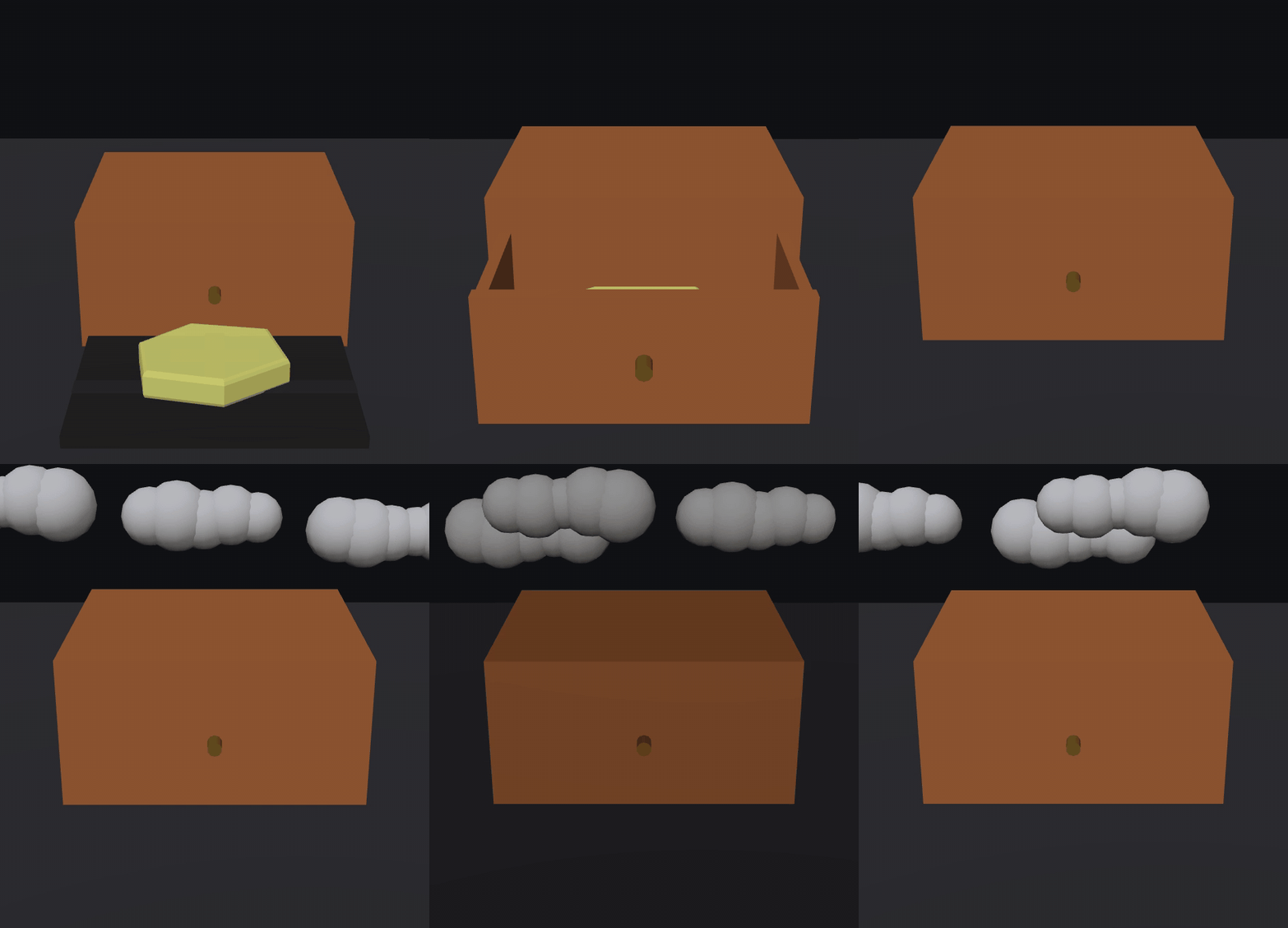
Figure 2. No sun: the plate, with the uranium salt on it, was put away in a drawer, and stayed there for several days in a row.
On March 1 he developed the plates anyway. He had expected the shadows to be very faint; it was the opposite, the outlines were very clear (Les silhouettes apparurent, au contraire, avec une grande intensité).
That plate can still be seen today. On it is his own handwriting: placed in diffuse light on the 26th, in the sun on the 27th, developed on March 1 (Exposé au soleil le 27. et à la lumière diffuse le 26. – Développé le 1er mars.). On the plate the shadow of a cross is still there: that is a thin copper cross, placed between the uranium salt and the plate.
He thought at once that in the dark, too, this action had not stopped, and went straight on to experiments to test it. In the same report he wrote: the same thin crystals of uranium salt, shielded from outside light and kept in the dark, still made the plate sensitive to light.
It is often said that Becquerel discovered radioactivity by accident, because of cloudy weather. The cloudy weather and the drawer are both real; he described them himself. But, knowing full well that the plates had sat in the drawer for several days, he still deliberately developed them; and after seeing the shadows, he went straight on to test them. Luck gave him a chance too, but the one who seized it was he himself.
That spring he tried the uranium salts at hand one by one: phosphorescent ones and non-phosphorescent ones; crystallized ones, melted ones, ones dissolved in water. The results were all much the same. On May 18 he reached his conclusion: what was acting was not phosphorescence, but the element uranium itself.
Uranium, without sunlight, without heating, without electricity, was by itself continually giving off rays.
How the news spread
In the spring of 1896, the French Academy of Sciences met every Monday. Of the six meetings from February 24 to March 30, Becquerel reported at five; on May 18 he reported once more.
The news reached the magazines. On March 15, Nuova Antologia, a literary and scientific magazine in Rome, wrote: Becquerel had found that uranium salts, after phosphorescing, give off rays that can pass through paper opaque to light and make silver salts sensitive to light. In May, the London popular monthly The Leisure Hour told it the same way: a crystal of uranium salt is placed on a sheet of aluminum, with a photographic plate beneath the aluminum; let the sun shine on it, and the shadow of the crystal appears on the plate.
Both pieces said the sun had to shine on it first. But Becquerel had already reported on March 2 that the plate was affected in the dark too, and none of these pieces we found mentioned it. We did not find the French newspapers of the time; there may be earlier, and more accurate, reports there.
Polonium and radium
Two years later, Marie took up the study of these rays.
She did not use photographic plates; she used a more precise method. Air does not normally conduct electricity. When rays pass through air, they tear air molecules apart into positively and negatively charged ions, and the air can then conduct. The stronger the rays, the better the air conducts. Spread the powder to be measured on a metal plate, put another plate a few centimeters above it, apply a voltage across the two plates, and measure how large the current flowing through is; that is all.
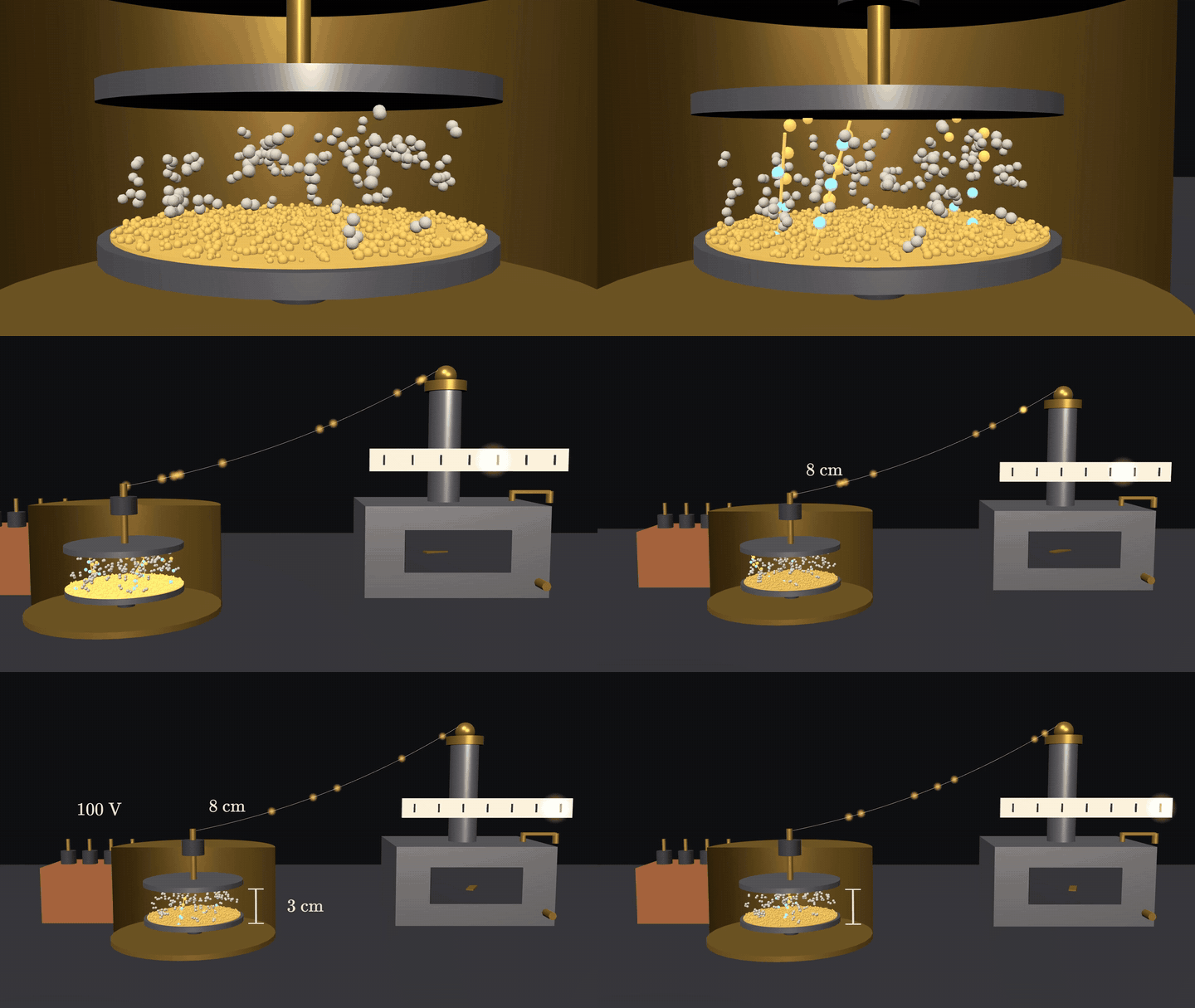
Figure 3. The rays tear air molecules into positive and negative ions, and the air can conduct; the stronger the rays, the larger the current. Marie used this current to measure the rays.
To read this current, she used the piezoelectric quartz discovered by Pierre and his brother. A pan is hung below the quartz and weights are slowly added to it; the charge the quartz releases is proportional to the weight, and its sign is just opposite to that of the charge the rays bring. By adjusting how fast the weights are added so that the needle of the electrometer stays still, the strength of the rays becomes two numbers: how heavy the weights added were, and how many seconds it took. In this way it can be read in absolute units.
She measured every compound and mineral she could find, one after another. Only those containing uranium or thorium gave noticeable rays. Thorium compounds were very active; thorium oxide was stronger even than pure uranium.
Then she saw something strange. Two uranium ores, pitchblende and torbernite, were much more active even than pure uranium. Yet the ores clearly contained less uranium than pure uranium. In her report of April 12, 1898, she wrote: this fact is very remarkable, and it leads one to believe that these ores may contain an element much more active than uranium.
The work that followed was done by the two of them together.
What they used was chemical separation: dissolve the pitchblende and divide it step by step into different parts; after each batch was separated out, measure it once with the electrometer, and whichever part was more active, follow that part further.
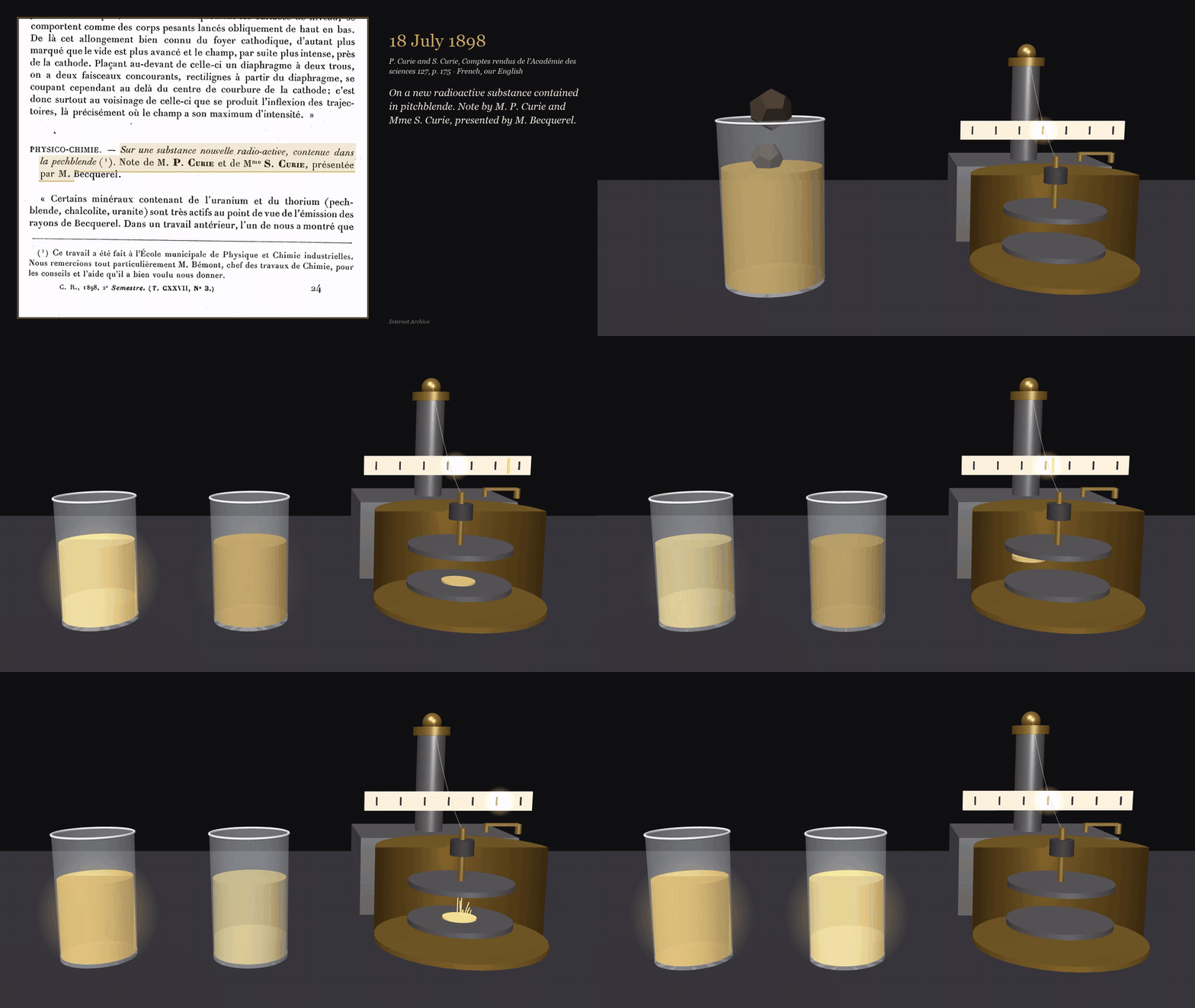
Figure 4. Chemical separation: dissolve the pitchblende, divide it step by step into several parts, and see which part the radioactivity follows.
In July 1898 they obtained a substance about 400 times as active as uranium. Chemically, it went along with bismuth.
They wrote in their report: we believe that this substance contains a metal not yet reported by anyone. If its existence is confirmed, we propose to call it polonium, after the native country of one of us. Marie’s native country was Poland, and at that time Poland was not an independent country: at the end of the eighteenth century it had been partitioned among Russia, Prussia and Austria, and it became independent again only in 1918.
The earliest piece we found is from the Polish-language newspaper Dziennik Polski of Lviv, August 14, 1898: on July 18, at the meeting of the Academy of Sciences in Paris, Mr. Curie and Mrs. Maria Skłodowska-Curie reported a new element which, if it really exists, is to be called polonium.
Five months later, on December 26, together with the chemist Gustave Bémont, they reported a second one.
This one went along with barium. The chloride they obtained was 900 times as active as uranium, and most of it was still barium. They proposed to call this new element radium. The report said: the radioactivity of radium must be enormous.
On the very next page is the report of the spectroscopist Eugène Demarçay: in the spectrum of this substance there is a line that belongs to no known element.
On December 28, the Chicago German-language newspaper Abendpost wrote on its front page: Dr. Becquerel has reported to the Academy of Sciences in Paris that another new chemical substance has been discovered, very close to barium, which its discoverers have named radium.
The shed
But to prove that radium really was an element, it had to be extracted on its own, and its atomic weight determined. There was far too little radium in the ore.
At the end of 1898, the Austrian government first sent, free of charge, 100 kilograms of pitchblende residues from St. Joachimsthal in Bohemia; the uranium had already been extracted, and the polonium and radium were still in them. In all, a ton was sent later, and the mine was allowed to sell them several more tons. Marie wrote that when the sacks arrived she was overjoyed, and pine needles were still mixed in with the brown powder.
Their laboratory was an abandoned shed on the other side of the school courtyard. Marie wrote in her book: plank walls, an asphalt floor, a glass roof that did not keep out the rain when it rained. Inside were a few old pine tables, a cast-iron stove that did not work well, and a blackboard that Pierre loved to use.
The raw material she processed at one time came to as much as twenty kilograms. She wrote in her English autobiography: “Sometimes I had to spend a whole day mixing a boiling mass with a heavy iron rod nearly as large as myself. I would be broken with fatigue at the day’s end.”
Sometimes, after dinner, they went back to the shed to have a look. The products they had extracted were set out on the tables and on boards. Marie wrote: all around were their faintly luminous silhouettes, and those lights, which seemed suspended in the darkness, moved and enchanted us every time.
All of this is her recollection twenty years later. The numbers from the time are in her doctoral thesis: in March 1902, Marie obtained 0.12 grams of radium chloride, in whose spectrum barium could still be seen. With it she made four measurements, and the atomic weight came out at about 223. She purified it once more, measured three more times, and fixed it at 225, with an error within 1. Today’s value is 226.
There was something stranger still. In March 1903, Pierre and Laborde reported: radium salts keep giving off heat by themselves, without stopping.
They measured 1 gram of barium chloride containing radium, which gave off about 14 calories of heat per hour. Estimated from its radioactivity, about one sixth of it was radium chloride. Converted, 1 gram of radium gives off about 100 calories per hour. That much heat is enough to bring 1 gram of water from the freezing point to the boil, once every hour.

Figure 5. Barium chloride containing radium gives off heat continually. Converted by the share of radium in it, one gram of radium gives about a hundred calories per hour.
And it went on giving off heat; over several years, no decrease could be seen. They worked it out: the heat given off per hour by 225 grams of radium is about the same as the heat given off by burning 1 gram of hydrogen in oxygen. But hydrogen, once burned, is gone; radium goes on giving off heat the next hour.
In June 1903, Marie defended her doctoral thesis with this work.
Ernest Rutherford recalled twenty-one years later that he came to Paris that summer and happened to arrive on the very day Marie received her degree. In the evening, Paul Langevin invited Rutherford and his wife, the Curies, and Jean Perrin to dinner. At eleven o’clock everyone went out into the garden, and Pierre brought out a tube coated with zinc sulfide and holding a radium solution, which shone brightly in the dark. He said that this was how the memorable day came to a close. He also saw Pierre’s hands: red and swollen, and very painful, the work of the radium rays. That was the only time he ever saw Pierre.
Why
Today we know that the nuclei of some atoms are unstable. An atomic nucleus is made of protons and neutrons. Protons all carry positive charge and repel one another; what pulls them together is a force that is very strong but acts only over extremely short distances. If the nucleus is too large, or the ratio of protons to neutrons is wrong, this force cannot hold it steady. Of the elements heavier than lead, not one is truly stable; uranium, polonium and radium are all on this side. Such a nucleus will, at some moment, break apart by itself, give off a small piece, and become another kind of atom. This needs no excitation from outside: no sunlight, no heating, no electricity. Becquerel said in his Nobel lecture that this emission is unrelated to any familiar source of excitation, whether light, electricity, or heat.
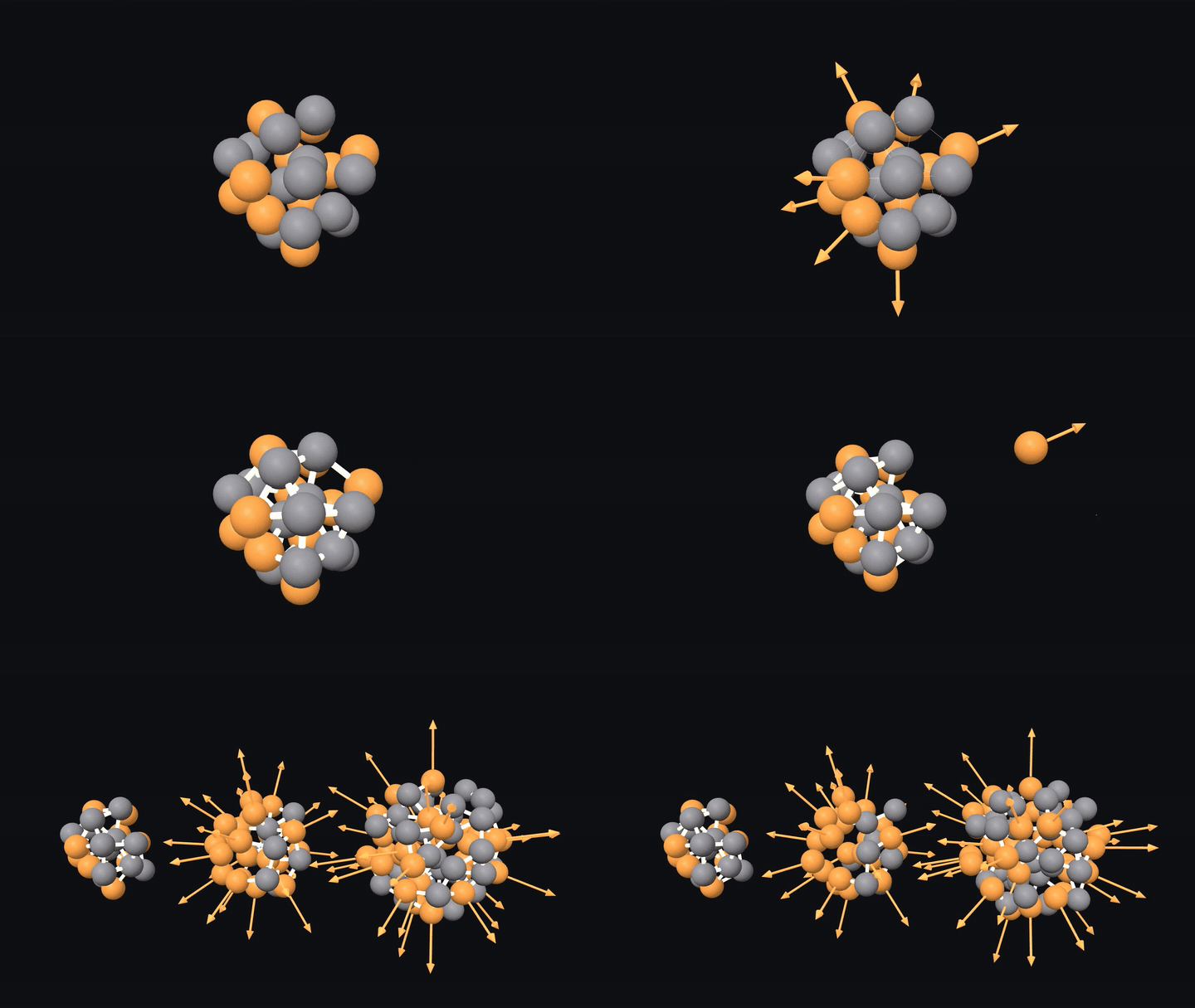
Figure 6. Protons carry positive charge and repel one another; the nuclear force that pulls them together acts only over extremely short distances. If the nucleus is too large, or the ratio of protons to neutrons is wrong, this balance is unstable.
So it is a property of the atom itself, and has nothing to do with what compound the atom is in, or what temperature it is at. At the end of 1898, in their report on radium, the Curies wrote: radioactivity appears to be an atomic property, which persists in all the chemical and physical states of matter.
Three kinds of rays
The rays given off by radioactive substances are of three kinds. A magnet is enough to separate them. Becquerel placed a few grains of radioactive substance on a wrapped photographic plate, and then put the plate between the two poles of a magnet. When it was developed, there was a large extra area of exposure on only one side of the source: these were the rays bent back onto the plate by the magnetic field.
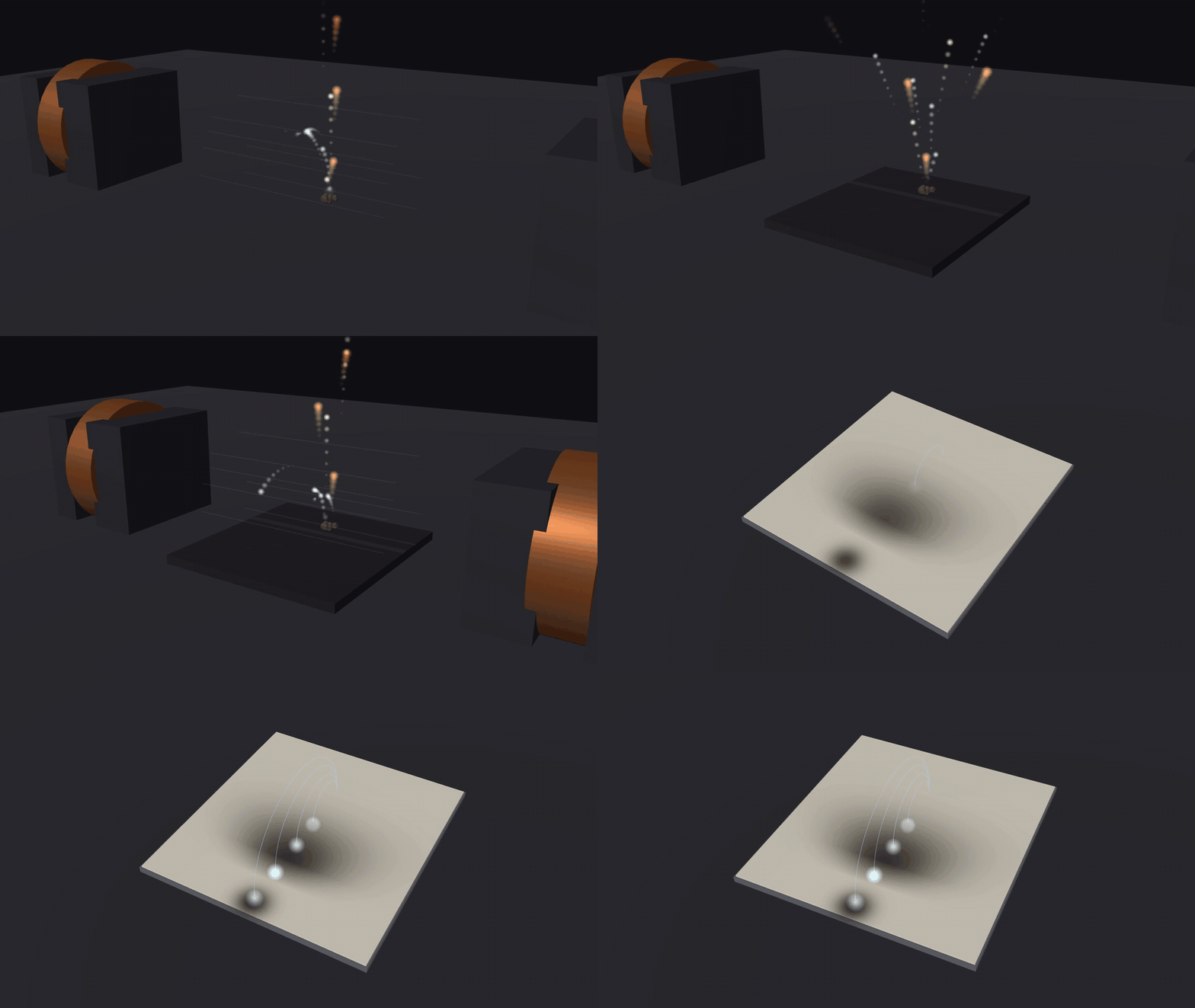
Figure 7. Becquerel’s magnet experiment: the plate is wrapped, and only on one side of the source is there a large extra area of exposure.
Later they were called α, β and γ rays. β rays bend strongly in a magnetic field. The Curies proved that they carry negative charge; they are electrons, the same as cathode rays. α rays are deflected extremely little, in the direction opposite to β, and a very strong magnetic field is needed to see it. They are nuclei of helium atoms, carrying two positive charges. γ rays are not deflected and are the most penetrating, able to pass through several centimeters of lead; they are of the same kind as X-rays, they are light.
Why is α so hard to deflect? It is more than seven thousand times heavier than the electron, and moves slowly too. In the same magnetic field, how much it bends is only about one thirtieth of Becquerel’s hardest β rays. Curie said in his Nobel lecture that it is like a positively charged projectile, and it was estimated at the time to be a thousand times heavier than the electron.
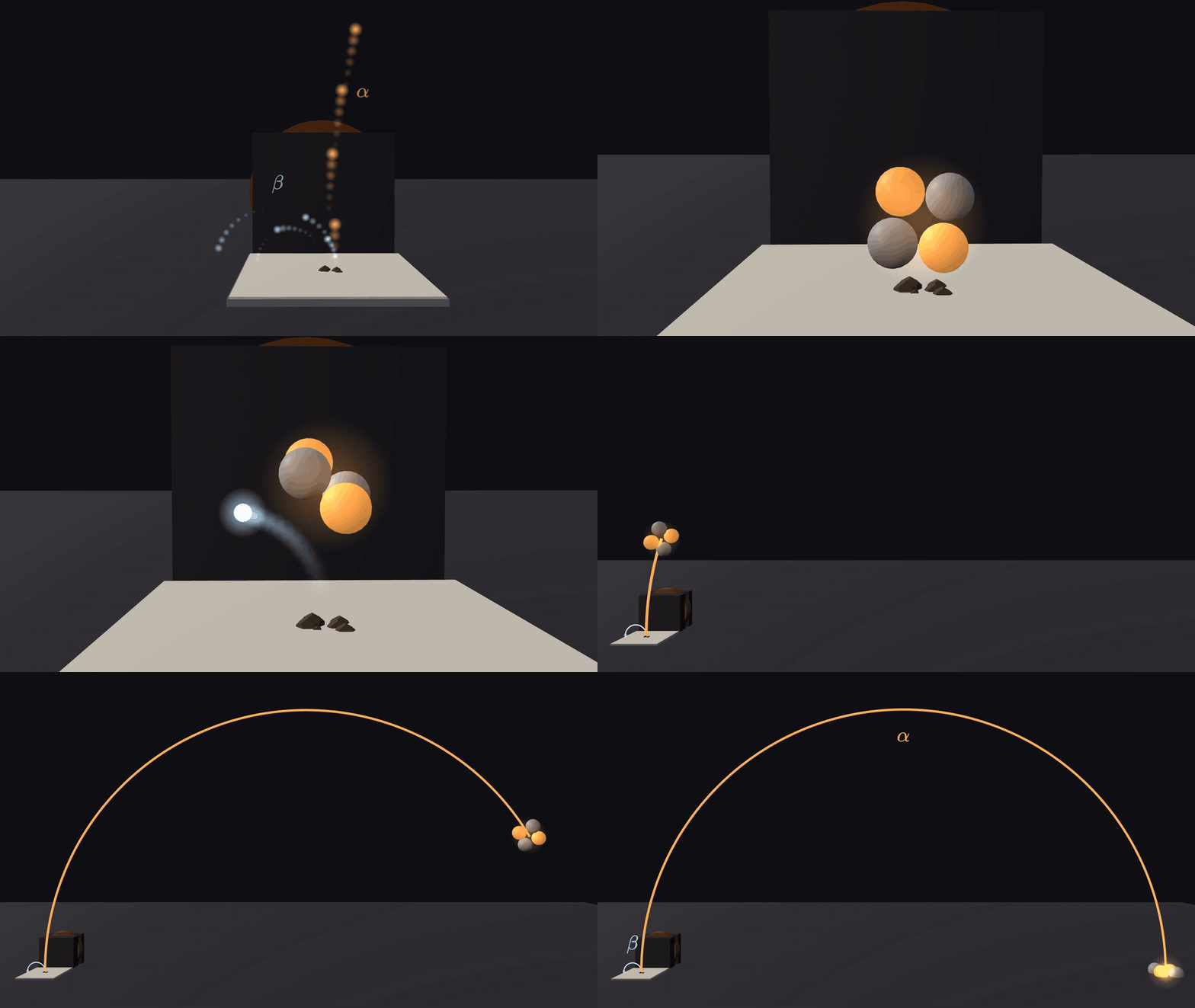
Figure 8. The α particle is more than seven thousand times heavier than the electron, and moves slowly too, so in the same magnetic field it bends only that little.
So which kind was it that in 1896 passed through the black paper and blackened the plate? What passed through was in fact β and γ. Becquerel himself said in his Nobel lecture that uranium, even in a vacuum, gives off only β rays; he added that he did not rule out some much weaker, undeflected rays as well.
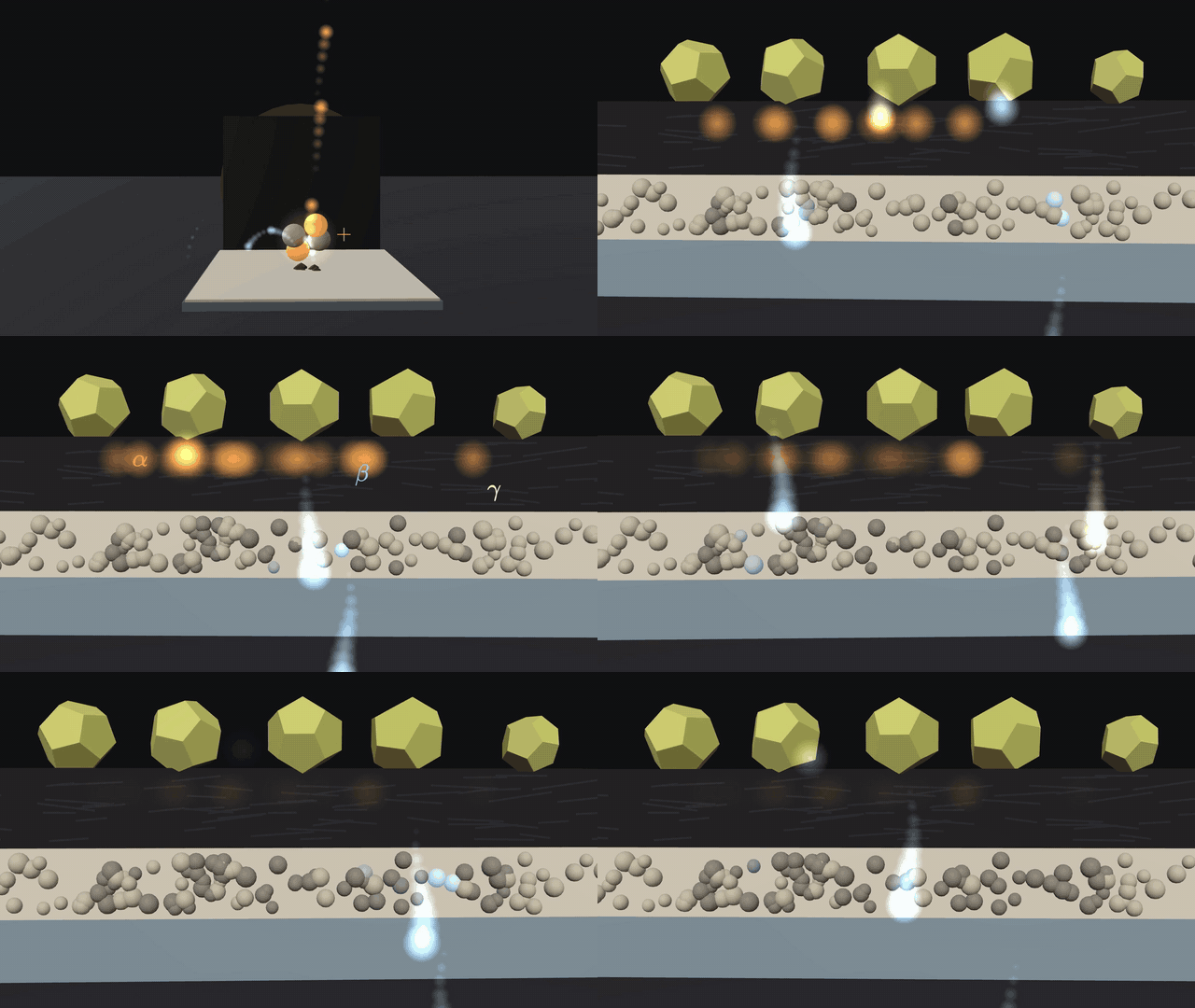
Figure 9. What passed through the black paper and blackened the plate was in fact β and γ; α cannot get through.
Moreover, these β were not given off by uranium itself. Uranium gives off α and becomes thorium; the thorium has a half-life of 24 days and becomes protactinium; the protactinium lives only about a minute, and gives off an electron of very high energy. In a uranium salt that has been kept a long time, they are constantly being produced and changing, together with the uranium. The shadows Becquerel saw from the drawer were left by these electrons.
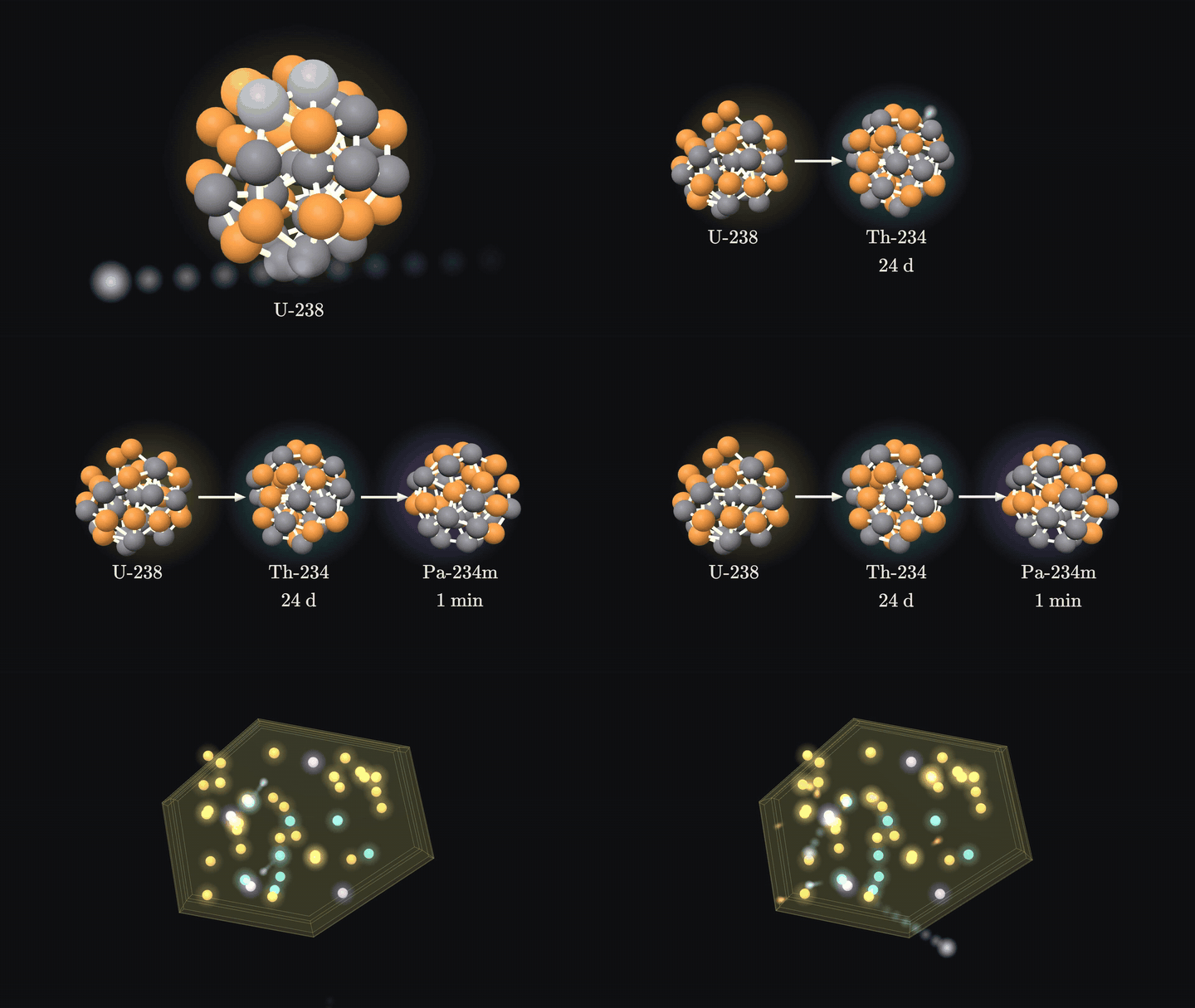
Figure 10. Uranium gives off α and becomes thorium-234, which gives off β and becomes protactinium. The electrons in the drawer came from these daughters.
The plate cannot tell light from electrons. On a photographic plate there is a layer of very small grains of silver bromide. When light falls on it, it gives its energy to a grain, and an invisible latent image is left in the grain, which on development becomes black silver. An electron passing through a grain also gives it energy. To the plate, the two are the same.
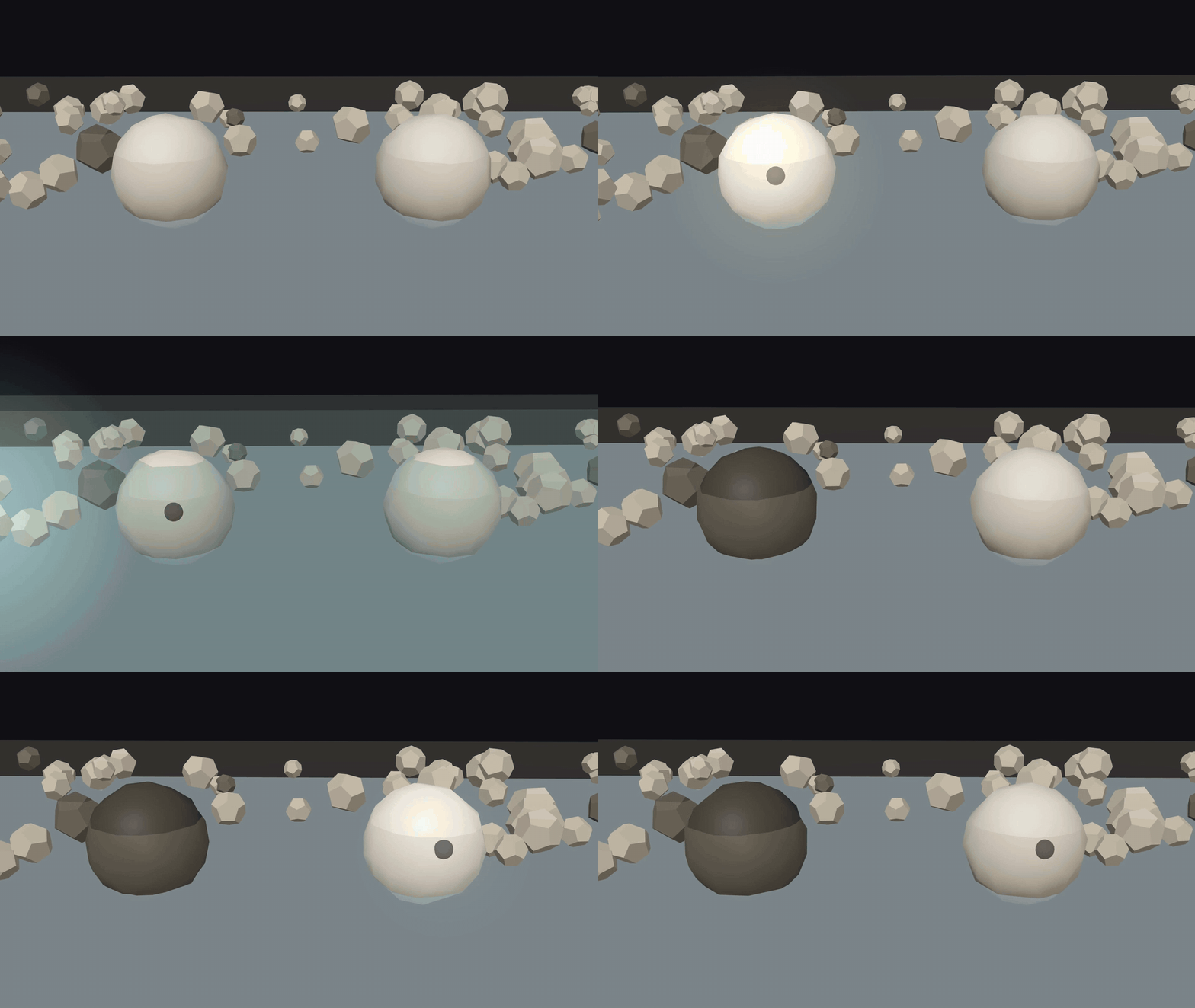
Figure 11. Light gives its energy to a grain of silver bromide, and so does an electron passing through the grain. To the plate, there is no difference between the two.
Where the heat comes from
Where, then, did the heat given off by radium come from? Pierre said in his Nobel lecture that Marie had put forward two possibilities in 1899 and 1900. One was that radioactive substances borrow energy from some invisible radiation outside. The other was that the energy comes from the substance itself: they are slowly changing into other things, only so slowly that in several years nothing can be seen.
The second was right. In 1902, Rutherford and Frederick Soddy wrote that “these changes must be occurring within the atom, and the radioactive elements must be undergoing spontaneous transformation.”
Pierre said in his lecture that this is a true theory of the transmutation of elements, but not the kind the alchemists understood.
Today, this can be worked out exactly. A radium nucleus gives off an α particle and becomes a radon nucleus. Put the two sides on a balance: the radium nucleus is heavier than the radon nucleus plus the α particle by a tiny bit, 0.005229 atomic mass units.
This bit of extra mass, converted into energy by , comes to exactly 4.87 megaelectronvolts. Almost all of it is carried off by the α particle; the recoiling radon nucleus gets only one part in fifty-odd. Einstein wrote this formula only in 1905; in 1903 it did not yet exist.
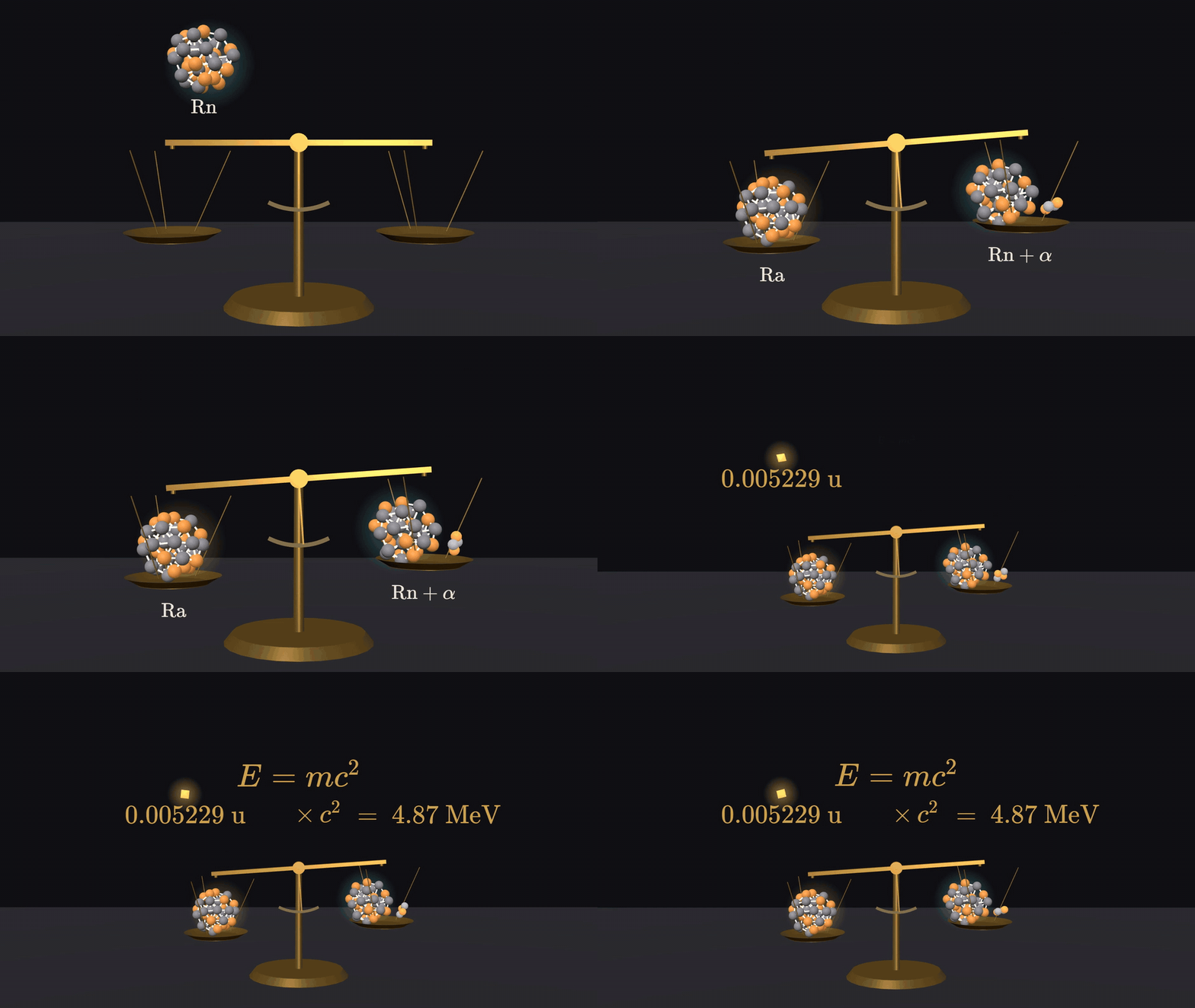
Figure 12. Put the two sides on a balance: the radium nucleus is a little heavier than the radon nucleus plus α. The extra mass, by E = mc², is the energy given off.
Counting only radium’s own α, it is just 25 calories per gram per hour. But when radium is left standing, the radon it produces, and the daughters after the radon, also give off α. Radium itself one, radon and its daughters three more: within a few weeks, 4 α in all. Counting them all, it is about 123 calories per gram per hour. The “about 100” that Curie and Laborde measured falls right between these two numbers.
In a chemical reaction, the energy given off per atom is a few electronvolts. One radium atom, in just these first four α, gives off more than 24 million electronvolts. The difference is several million times. When they said that this cannot be explained by any ordinary chemical change, this is what they meant.
There is one more question: why is radium so much stronger than uranium? Becquerel said about a million times stronger; Curie said of the order of two million times. The difference is not in the energy given off each time. The α that radium and uranium give off each time have about the same energy. The difference is in frequency: for the same number of atoms, the number of radium atoms breaking apart each second is several million times that of uranium. This can be worked out in the next section.
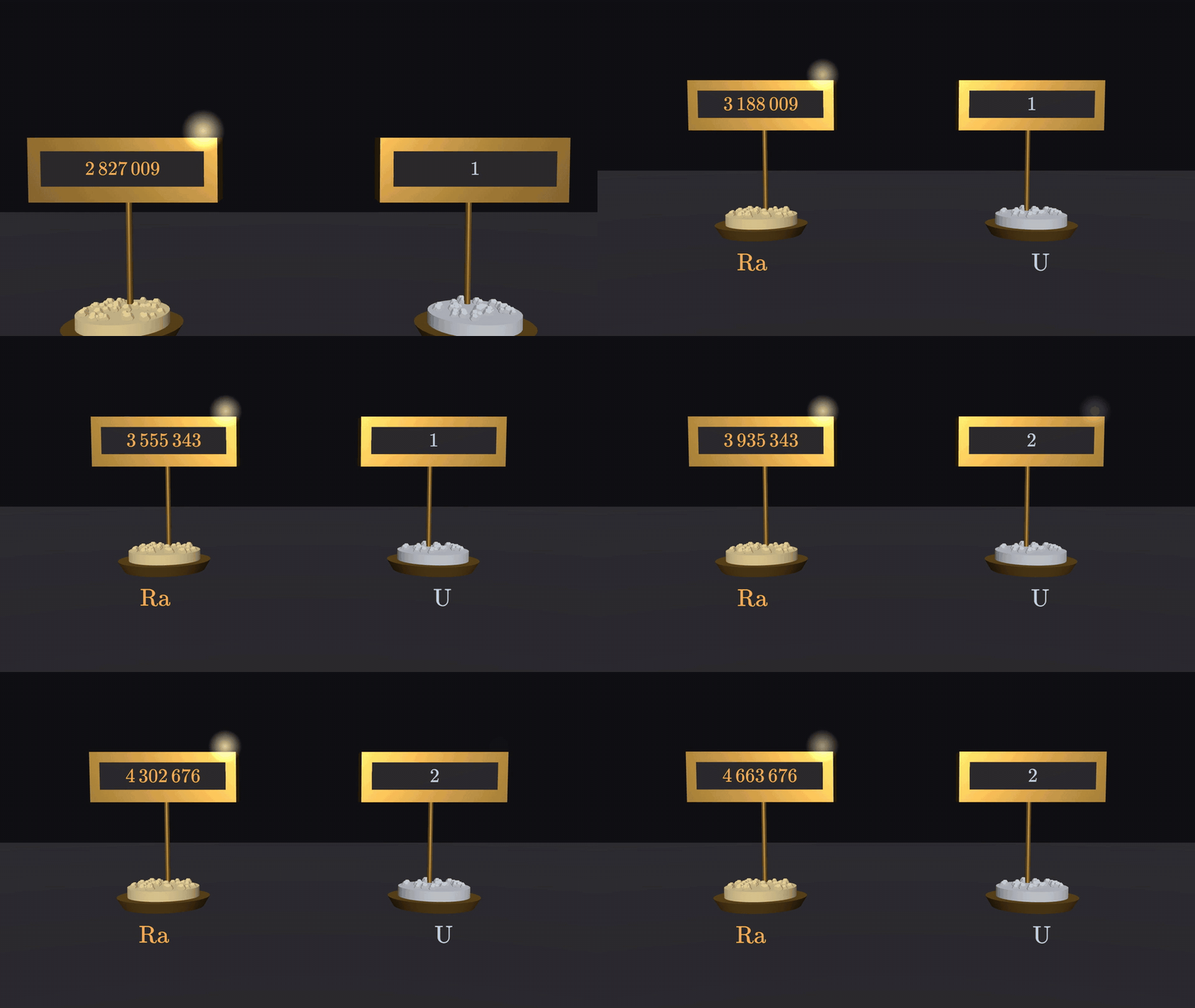
Figure 13. The difference is in frequency: for the same number of atoms, many more radium atoms break apart each second than uranium atoms.
Working it out from the start
A heap of atoms. When each one will break apart, nobody knows, and there is no way to make it a little faster or a little slower. But at every instant, the proportion that breaks apart is the same.
Take a short time . The number breaking apart in this time is proportional to the number present, , and also proportional to the length of this time. The proportionality constant is called ; it is a property of this kind of atom itself:
Divide both sides by and integrate, and you get the solution:
At every instant the same proportion is lost; put together, that is exponential decay. The randomness is in each single atom; the law is in a large heap of atoms.
If each interval of time lost the same number, that would be a straight line, soon falling to zero. Losing the same proportion is a curve that gets flatter and flatter and never reaches zero.
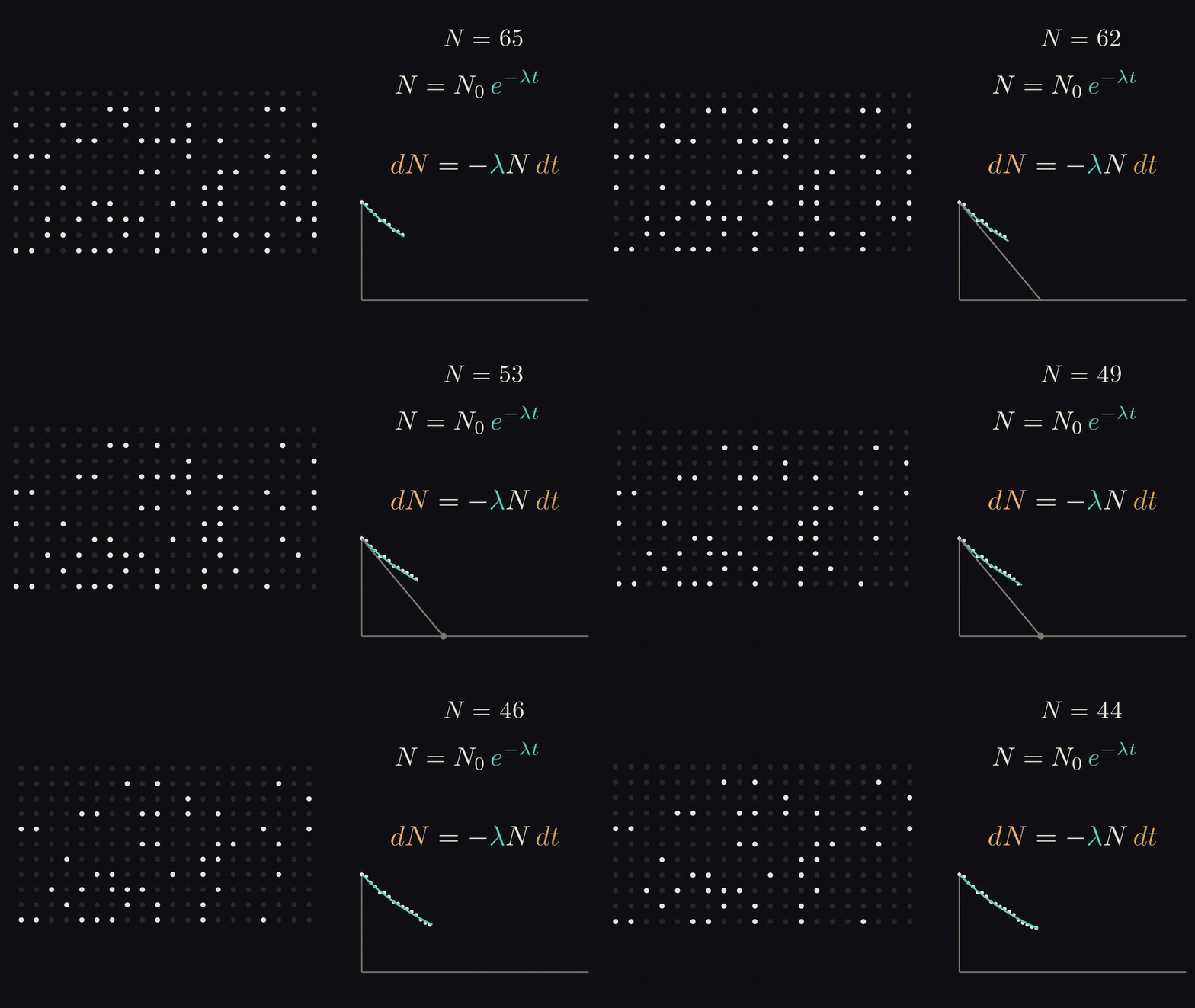
Figure 14. Losing the same number in each interval is a straight line; losing the same proportion is a curve that gets flatter and flatter.
How long it takes for the number to fall to half is called the half-life. Setting , we get:
After another half-life, a quarter is left; after another, an eighth.
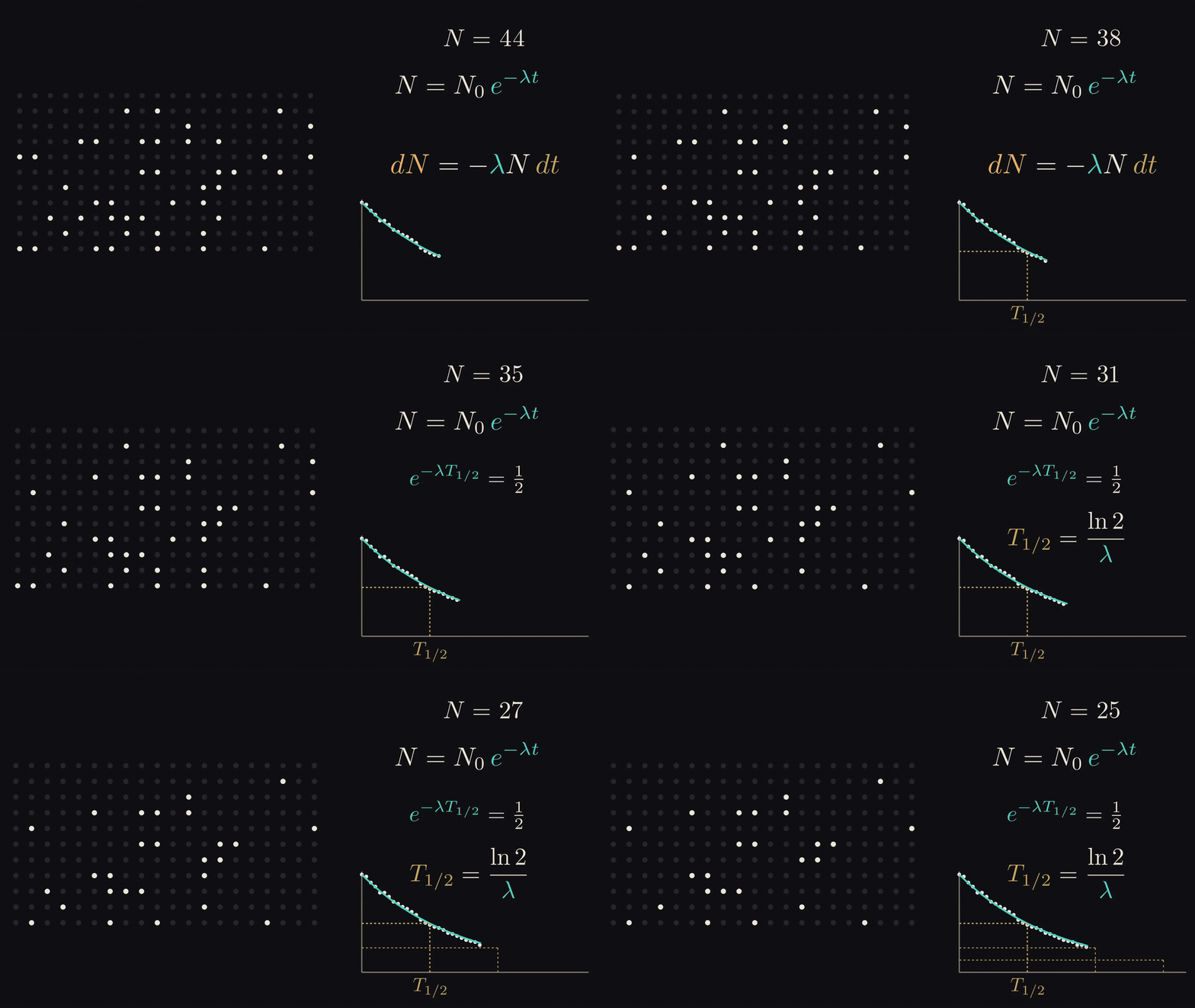
Figure 15. How long it takes for the number to fall to half is called the half-life. After another half-life, a quarter is left; after another, an eighth.
Put in the numbers. Pierre said in his lecture that polonium decreases by half every 140 days, and after a few years has almost completely disappeared. Work it out:
After one year a sixth is left; after three years, four thousandths.
The half-life of radium is 1600 years. Over five years:
Only two thousandths are lost. When it was said at the time that radium showed no decrease over several years, that was not wrong: two thousandths could not yet be measured then.
The number breaking apart each second is called the activity; it equals times the number of atoms. In 1 gram of radium there are atoms, and :
In 1 gram of radium, about 37 billion atoms break apart each second. This number later became a unit, called the curie.
Finally, back to that question: why is radium a million times stronger than uranium? The half-life of uranium is 4.47 billion years, nearly three million times that of radium. For the same number of atoms, the number of radium atoms breaking apart each second is then nearly three million times that of uranium. For the same weight, one must also multiply by the inverse ratio of the atomic weights:
If one really compares two pieces of the same weight, the uranium piece also contains uranium-234, which keeps decaying along with it; counting that, the ratio against freshly purified radium is 1.4 million. Leave the radium standing for a month and its daughters catch up too; counted by the number of α, it becomes 5.8 million. Becquerel said a million times, Curie said two million times; what they measured was ionization current, and both are of this order.
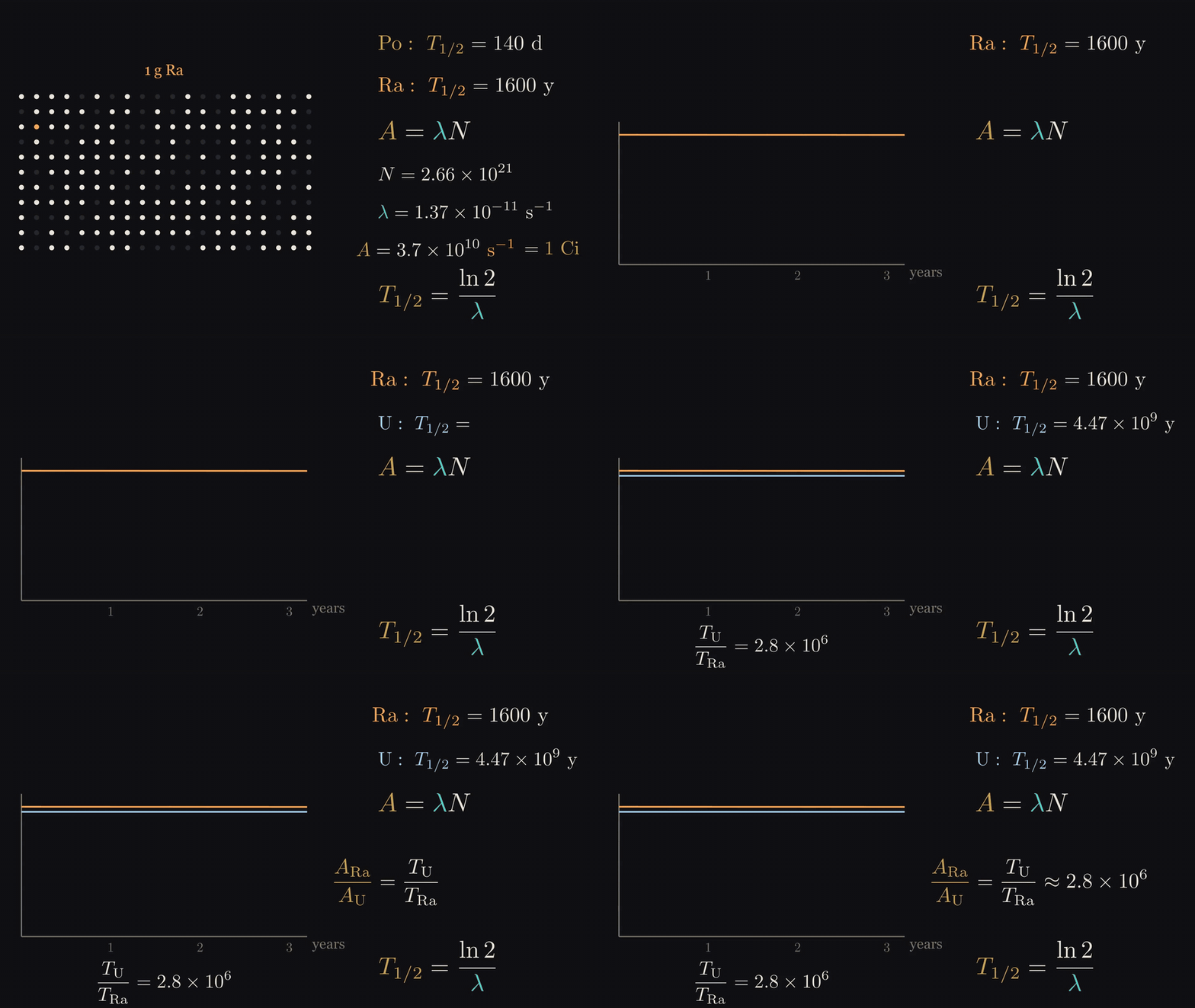
Figure 16. The half-life of uranium is nearly three million times that of radium, so for the same number of atoms, the number of radium atoms breaking apart each second is also nearly three million times that of uranium.
December 1903, Stockholm
In January 1903, the French mathematician Poincaré drafted a letter of nomination for the Nobel Prize, and twenty members of the French Academy of Sciences signed it. The letter said that this discovery was to be credited to Mr. Becquerel and Mr. Curie, and proposed that the prize be shared between the two of them. Marie was not in the letter.
A researcher at the Musée Curie, in a 2017 paper, quoted a letter Pierre wrote to Poincaré on January 25. The letter says: it was she who had the courage to begin searching for new elements with chemistry; all the steps of separating radium were done by her; the atomic weight of radium was measured by her. If we are not regarded as one, that amounts to saying that she was only a laboratory assistant, which does not match the facts.
In the end, Marie’s being on the list depended on another nomination. Charles Bouchard’s nomination that year named all three.
On November 12, 1903, the Royal Swedish Academy of Sciences decided: this year’s physics prize, one half to Becquerel, for his discovery of spontaneous radioactivity; the other half to Pierre Curie and Marie Curie, for their joint research on the radiation phenomena discovered by Professor Becquerel.
The Curies’ diploma reads: to Pierre Curie and his wife, Madame Marie Curie (till PIERRE CURIE och hans hustru fru MARIE CURIE). Where the diploma mentions Becquerel, the name is even misspelled, missing a c (Bequerel).
The prize was presented on December 10. The president of the Royal Swedish Academy of Sciences, Törnebladh, said in his speech: the success of Professor and Madame Curie is the best illustration of an old saying, union is strength. This makes us see God’s word in an entirely new light: it is not good that the man should be alone; I will make him an help meet for him.
He also said that to obtain a few tenths of a gram of this active substance, a thousand kilograms of raw material were needed.
The Curies did not come. The president said that the two laureates were prevented by commitments from attending, and that the French Minister, Marchand, would receive the prize on their behalf.
He turned to Becquerel and said to him: your victory is a forceful refutation of that ancient dictum, we do not know, and we shall never know.
Marie was the first woman to receive a Nobel Prize.
On December 11, Becquerel gave his Nobel lecture, titled “On Radioactivity, a New Property of Matter”. Speaking of the 1896 discovery, this is how he put it: he first exposed the uranium salt to the sun for several hours, developed shadows, and very soon recognized that this emission had nothing to do with light. Of the cloudy weather and the drawer, he did not say a word.
Radium later became a business. Marie wrote in her book: we did not apply for any patent, and we published the methods of extracting radium without any reservation.
The Curies came to Stockholm only a year and a half later. On June 6, 1905, Pierre gave his Nobel lecture, titled “Radioactive Substances, Especially Radium”. At the beginning he apologized for being late: we have come to visit you in Stockholm so late for reasons beyond our control. Marie did not give a lecture.
He had brought from Paris a tube of the gas given off by radium, and demonstrated it on stage: it made an electroscope discharge, and made zinc sulfide glow.
At the end of the lecture he warned everyone: put a small tube of radium salt in your pocket, and for a few hours you feel nothing at all; but fifteen days later the skin turns red, then ulcerates, and it is very hard to heal. With a longer time, there will be paralysis, there will be death. Radium must be transported in a thick lead box.
He also said that radium would become very dangerous in the hands of criminals. His last sentence was: like Nobel, I believe that new discoveries will bring mankind more good than harm.
What the archives say
The nomination archive of the Nobel Prize is now public. For the 1903 physics prize there were 35 nominations in all.
Of these, 6 concern these three people, and Marie appears in only 1:
| Nominator | Nominated |
|---|---|
| Berthelot | Becquerel |
| Bouchard | Becquerel, Marie Curie, Pierre Curie |
| Darboux | Becquerel, Pierre Curie |
| Gabriel Lippmann | Becquerel, Pierre Curie |
| Éleuthère Mascart | Becquerel, Pierre Curie |
| Poincaré | Becquerel, Pierre Curie |
That 2017 paper says that, of the twenty signatories of the joint letter, only four had the right to nominate: Poincaré, Mascart, Lippmann, Darboux. In the archive, the entries that read “Becquerel, Pierre Curie” are exactly these four. The letter on one side, the archive on the other: the sources are different, and the numbers agree.
It is not that Marie had never been nominated. In 1902, the nominations by Darboux and by Emil Warburg both named her. The same Darboux named Marie in 1902 and did not in 1903. Why, the archive page does not say.
That summer, Pierre wrote again, to the Swedish mathematician Gösta Mittag-Leffler, saying that if he was really being considered, he hoped that he and Madame Curie would be treated as one. Mittag-Leffler privately asked Poincaré: would it be fairer to give it to Mr. and Madame Curie, or one share to Becquerel and one share to the Curies? Poincaré wrote back that separating them was fairer, because Becquerel was the pioneer.
We have not seen the originals of these letters; all of them are quoted from that paper. As to whether Marie knew at the time that Pierre was fighting for her, the author of the paper says: we do not know.
Of the other 29, Svante Arrhenius and Lord Rayleigh had 7 each, and Guglielmo Marconi 6. Arrhenius received the chemistry prize that year, and Rayleigh the physics prize the following year. One more nominated Lippmann, and the nominator was Becquerel himself. Ludwig Boltzmann also received 1; he never won the prize in his life.
Several stories also circulate online; a word about them too.
“Marie kept radium by her bed as a night light”: this is not in her own book. The glow she wrote about was those silhouettes seen when they went back to the shed at night. This detail is said to come from a 2005 biography, which we have not seen.
“She gave the gold medal of the British Royal Society to her younger daughter as a toy, saying honors are like toys”: this is not in her book, and we have not found any other source either.
“Pierre’s accident: the wagon weighed six tons, was loaded with military uniforms, and an umbrella blocked his view”: none of this is in Marie’s book or in Langevin’s article of the time. If these details have a source, it is probably in the French newspapers of 1906, which we were unable to open.
“Marie was the first woman to enter the Panthéon”: Mitterrand’s actual words were the first on account of her own merits (honorée pour ses propres mérites).
“The polonium paper is where the word radioactivity first appeared”: in that paper radio-active appears only in the title, and whether this is the first time, the paper itself cannot prove.
“The first woman to receive a Nobel Prize” is correct, though the official website does not have this sentence. In the official website’s list of women laureates, she is the earliest row; the next is Bertha von Suttner, Peace Prize 1905.
The prize money
The prize money in 1903 was 141,358 Swedish kronor, 91% of that of 1901. Becquerel received half, 70,679 kronor; the Curies, the two of them together, received the other half.
Afterwards
In July 1905, Pierre was elected a member of the French Academy of Sciences.
On April 19, 1906, crossing the street in the rue Dauphine in Paris, Pierre was knocked down by a goods wagon coming from the direction of the Pont Neuf, fell under its wheels, and died on the spot. He was 46.
Marie wrote in her book that he had come back to Paris for a dinner of the Physical Society, sat next to Poincaré, and talked with him for a long time about how to teach. In December that year, Poincaré said at the Academy’s annual meeting: on the evening before his death I sat next to him, and he told me about his plans and his ideas; the next day, everything was reduced to nothing in an instant.
The same year, Marie took over his course at the Sorbonne. Two years later, she became full professor.
In August 1908, Becquerel died suddenly, aged 55.
In January 1911, Marie stood for election to the French Academy of Sciences. In the second round, with 58 voting, Édouard Branly had 30 votes and she 28, and she was not elected. Twenty-three years later, the Academy said in its eulogy for her that the number of votes she received then was one that first-time candidates rarely reach; that the dispute at the time was over whether women should enter the Academy; and that she never afterward agreed to stand again.
In December of the same year, she alone was awarded the Nobel Prize in Chemistry. This time, she went to Stockholm. The official Nobel website says that she was the first person to receive two Nobel Prizes.
On May 20, 1921, at the White House, the American president Warren Harding put a small vial of radium into her hands. It was 1 gram of radium, bought with money donated voluntarily by American women.
According to the recollection of the organizer who was present, Marie Mattingly Meloney, on the evening before the presentation Marie read the deed of gift and insisted that this gram of radium must not belong to her personally but must belong for all time to the use of science, and that the deed had to be changed that same night: “To-morrow I receive the radium, and I might die tomorrow.”
On July 4, 1934, Marie died, aged 66. The Academy’s eulogy five days later said that this short illness appeared to have been caused by the radiation she had received in her daily work. The obituary of the New York Academy of Medicine said that she died of pernicious anemia, in all probability resulting from long exposure to radium.
Her laboratory notebooks from those years still exist today. It is often said that these notebooks are radioactive to this day, locked in lead boxes, and that readers must sign a liability waiver and wear protective clothing to see them. The Bibliothèque nationale de France’s own account is: the few most contaminated pages have been sealed off, and the originals can be consulted only on very special request; at exhibitions, standing in front of two of the notebooks for 10 minutes, the dose received is very small, about 2 nanosieverts. Lead boxes, waivers, protective clothing: none of them are on the library’s pages.
On April 20, 1995, the remains of Pierre and Marie were moved into the Panthéon in Paris. The French president François Mitterrand said that she was the first woman in our history to enter the Panthéon on account of her own merits.
Today, the international unit of radioactive activity is called the becquerel: one decay per second is 1 becquerel. There is also an old unit, called the curie.
A photographic plate wrapped in black paper, a sun that did not come out for several days, a drawer. From here, we learned that atoms break apart by themselves and become another kind of atom.
The next episode is 1904, Rayleigh: the nitrogen from the air was five thousandths heavier than nitrogen made by chemical methods.
Appendix A: Physics derivations
The main-text sections “Where the heat comes from” and “Working it out from the start” used four things for which only the results were given there: why there are 4 α, how the 25 calories and the 123 calories come about, why α is thirty times harder to deflect than β, and how many times stronger radium is than uranium. This appendix derives them. All the numbers have been computed by script, and the masses and half-lives are from the IAEA data tables.
Notation in this appendix
| Symbol | Meaning |
|---|---|
| y, d | year, day |
| , | number and activity of nuclei of the -th kind, , in units of “per second” |
| , | decay constant, half-life, |
| , | atomic mass of X; written when only the mass number is taken |
| energy released in one decay | |
| Avogadro constant | |
| , , , | magnetic field, particle charge, momentum, radius of the circle |
| Lorentz factor, used only in A.3 | |
| calorie | 1 calorie joules |
A.1 Decay chains and secular equilibrium
Definition A1.1 (two-step decay). Nuclei of kind 1 decay into kind 2, and kind 2 decays further. The numbers satisfy
Of the two terms in the second equation, one is what is produced, and the other is what decays away.
Proposition A1.2. If , then
Proof. From the first equation of (A1.1), . Multiply both sides of the second equation by , and the left side combines into a total derivative:
Integrate from 0 to , substitute , then multiply by , and (A1.2) follows. (QED)
Corollary A1.3 (secular equilibrium). From (A1.2),
If , that is, the parent lives much longer than the daughter, then . After a few , the two activities are equal, and the number of daughter nuclei stays at
Remark A1.4. This result can be seen without solving the equations. The daughter accumulates more and more, and more and more of it decays away too, until the number decaying away each second equals the number produced each second, and then the number no longer changes. The limit of (A1.3) is in fact , which for radon and radium is greater than 1 by only .
Example A1.5 (radon catches up with radium). days; by (A1.3):
| Time standing | 1 day | 3.82 days | 7 days | 14 days | 30 days |
|---|---|---|---|---|---|
| Radon activity / radium activity | 16.6% | 50.0% | 71.9% | 92.1% | 99.6% |
This is the “few weeks” of the main text. By (A1.4), the radon in equilibrium with 1 gram of radium is only 6.4 micrograms.
Example A1.6 (how much radium there is in uranium ore). Uranium-238 passes through several generations to reach radium; after standing long enough, the activity of every generation equals the activity of the uranium-238. By (A1.4), ; multiplied by the mass ratio 226/238, each ton of uranium-238 goes with 0.34 grams of radium. The radium in the ore comes, at most, to this much.
Where the 4 α come from. The stretch below radium (branches below one in a thousand not counted):
| Nucleus | Half-life | Decay | (MeV) |
|---|---|---|---|
| Radium-226 | 1600 years | α | 4.871 |
| Radon-222 | 3.82 days | α | 5.590 |
| Polonium-218 | 3.10 minutes | α | 6.115 |
| Lead-214 | 27.1 minutes | β | |
| Bismuth-214 | 19.7 minutes | β | |
| Polonium-214 | 164 microseconds | α | 7.834 |
| Lead-210 | 22.2 years |
The four generations after radon each last less than half an hour, so they follow right behind the radon. Radon is the slowest link in this stretch, and it sets the pace of the whole stretch. At lead-210 it gets stuck: its half-life is 22 years. We integrated the equations for these 7 nuclei numerically: at 60 days, the activities from radon to polonium-214 all differ from that of radium by less than one in a thousand, and lead-210 is still less than 0.5% of radium.
So within “a few weeks”, each radium nucleus that decays is followed by 3 α, 4 in all. The 5th α comes from polonium-210, which comes after lead-210 and has to wait several decades. All the way to stable lead-206, there are 5 α in all, releasing 35.33 MeV.
Remark A1.7. Radon is a gas. If the sample is not sealed and the radon escapes, the three α after it are not given off in the sample. Equilibrium is a matter for sealed samples.
A.2 The Q value and 25 / 123 calories
Definition A2.1. Radium-226 gives off α and becomes radon-222; the energy released is
Atomic masses are used here: 88 electrons on the left, 86 + 2 on the right, so the electrons cancel exactly.
Example A2.2. , , (in u). The difference is u; multiplied by 931.494 MeV/u, MeV. The value in the IAEA table is also 4.8707.
Proposition A2.3 (how the energy is shared). If the radium nucleus is at rest before the decay, then
Proof. By conservation of momentum, the two have momenta of equal magnitude, written . The speeds here are far below the speed of light, and kinetic energy is , so kinetic energy is inversely proportional to mass. Also , which gives (A2.2). (QED)
Putting in the numbers, MeV and MeV; the recoil takes about one part in 56. The strongest α line measured is exactly 4.784 MeV (94% of decays). This is an independent check: (A2.1) uses masses that were weighed, and this line is an energy that was measured.
Proposition A2.4 (heat output). 1 gram of radium decays times per second, releasing each time, so the heat output is . Here
Each 1 MeV released per decay corresponds to 5.042 calories per gram of radium per hour.
Proof. joules seconds joules per calorie calories. (QED)
Example A2.5. Multiplying by the of each step:
| Radium-226 | Radon-222 | Polonium-218 | Polonium-214 | Total | |
|---|---|---|---|---|---|
| (MeV) | 4.871 | 5.590 | 6.115 | 7.834 | 24.41 |
| cal / (g·h) | 24.6 | 28.2 | 30.8 | 39.5 | 123.1 |
These are the 25 and the 123, about 0.143 watts. It is assumed here that the energy of the α and of the recoil nucleus all stays in the sample, which is the case for a somewhat thick sample.
By (A1.3), for a freshly purified piece of radium the heat output rises with time, :
| Time standing | 1 day | 3.82 days | 7 days | 14 days | 30 days |
|---|---|---|---|---|---|
| cal / (g·h) | 41 | 74 | 95 | 115 | 123 |
Remark A2.6. There are also two β. The electrons carry off 0.87 MeV on average; counting them, it is 127 calories. The γ mostly pass out of the sample, and are not necessarily counted in the calorimeter. Curie and Laborde measured “about 100” using barium chloride containing radium, which converts to about 110 per gram of radium. We have not looked closely into how long their sample had stood or how it was sealed, so here we say only that the order of magnitude agrees.
Remark A2.7. A chemical bond is a few eV; for example, burning hydrogen releases about 3 eV per water molecule. 4 α release eV, a difference of about 8 million times.
A.3 The ratio of the bending radii of α and β
Proposition A3.1. A particle of charge and momentum entering a magnetic field perpendicularly moves in a circle of radius
This holds equally in the relativistic case, with .
Proof. The Lorentz force is perpendicular to the velocity and does not change the speed, so does not change. Circular motion requires ; eliminating gives (A3.1). (QED)
So what determines the bending is the momentum per unit charge, , and it has no direct relation to the mass.
Example A3.2. For an α of 4.784 MeV, , MeV/, and the charge is . For β, relativity is needed: , where is the kinetic energy. With tesla:
| Kinetic energy (MeV) | (MeV/) | (cm) | Radius of α / its radius | ||
|---|---|---|---|---|---|
| α (radium-226) | 4.784 | 0.051 | 188.9 | 31.5 | |
| β (bismuth-214, hardest) | 3.269 | 0.991 | 3.745 | 1.25 | 25 |
| β (protactinium-234m, hardest) | 2.270 | 0.983 | 2.734 | 0.91 | 35 |
| β (1 MeV) | 1.000 | 0.941 | 1.422 | 0.47 | 66 |
| β (0.1 MeV) | 0.100 | 0.548 | 0.335 | 0.11 | 282 |
The “about one thirtieth” of the main text refers to the hardest β, and lies right between 25 and 35. The energy of β is continuous, and the softer ones bend more, so this ratio is not a fixed number. We also integrated the Lorentz force directly: an α going once around in 1 tesla has a radius of 31.47 centimeters, which differs from the 31.51 centimeters of (A3.1) by 0.1%.
Remark A3.3 (why it is not thousands of times). α is 7295 times heavier than the electron and carries 2 times the charge. If the two were equally fast, the ratio of radii would be 3647. But α is slow, ; the hardest β is close to the speed of light, with , so its momentum is several times larger again. .
A.4 The radium-to-uranium activity ratio and uranium-234
Proposition A4.1. For two pure nuclides of the same mass , the activity ratio is
Proof. , , , so . Dividing one expression by the other, , and all cancel. (QED)
Putting in years and years: for the same number of atoms it is times, and for the same weight times.
Uranium-234. Real uranium is not pure uranium-238. Uranium-238 gives off α and becomes thorium-234 (24 days), then through protactinium-234m (about 1 minute) becomes uranium-234, which has a half-life of 245,500 years and gives off α in turn. These three generations are much shorter-lived than uranium-238, so in uranium that has stood a long time they are all already in equilibrium. By (A1.4):
The abundance ratio measured in natural uranium is , a difference of 1%. This is an independent check: the abundances are measured by mass spectrometry, while (A4.2) uses only two half-lives.
Example A4.2 (how many α 1 gram of natural uranium gives off per second).
| Uranium-238 | Uranium-234 | Uranium-235 | Total | |
|---|---|---|---|---|
| α / second | 12346 | 12346 | 576 | 25268 |
Uranium-238 and uranium-234 have equal activities; this is the equilibrium. Uranium-235 makes up 0.72% by weight and has a much shorter half-life, and contributes 4.7%. Hence
The 1.4 million of the main text is this number. Take uranium-234 out, and it is .
Remark A4.3 (what this ratio compares). The uranium in (A4.3) includes its daughter uranium-234, while the radium counts only itself, so what it compares is freshly purified radium with uranium that has stood a long time. Leave the radium standing for a month and, by A.1, each radium nucleus comes with 4 α; counted by the number of α, the ratio becomes . Becquerel’s million times and Curie’s two million times both measured the ionization current of air, not the number of α. The range of the α, the thickness of the sample, and how long it has stood all affect this current, so only orders of magnitude can be compared, and it cannot be used to decide which number is more correct.
References
Numbered in order of first appearance in the main text. [primary] = original documents, newspapers and periodicals of the time, or institutions’ own catalogue records; [secondary] = later research or retellings; [own recollection] = Marie Curie’s later writings, first-hand for herself, but written some twenty years after the events.
- Victoria Daily Times (Victoria, Canada), 1903-03-07, p. 10 (page number poorly printed), RADIUM NOW ONLY $900,000 A POUND (archive.org victoriadailytimes19030307) [primary]: https://archive.org/details/victoriadailytimes19030307
- Radium—the Wizard Metal, Harper’s Weekly, 1903-04-25 (archive.org sim_harpers-weekly_1903-04-25_47_2418) [primary]: https://archive.org/details/sim_harpers-weekly_1903-04-25_47_2418
- J. M. Price, caricature of the Curies, Vanity Fair, 1904 (Wellcome Collection egr2w5jx) [primary]: https://wellcomecollection.org/works/egr2w5jx
- H. Becquerel, P. Curie, Action physiologique des rayons du radium, Comptes rendus 132 (1901-06-03), pp.1289–1291 (archive.org comptes-rendus-lacademie-des-sciences-vie-academique_1901-06-03_132_22) [primary]: https://archive.org/details/comptes-rendus-lacademie-des-sciences-vie-academique_1901-06-03_132_22
- Mme Curie, Pierre Curie (Paris: Payot, 1924), full text on Wikisource; M. Curie, Pierre Curie, with Autobiographical Notes and an introduction by M. M. Meloney (New York: Macmillan, 1923), Project Gutenberg #69617 [own recollection]: https://fr.wikisource.org/wiki/Pierre_Curie_(Marie_Curie)/Texte_entier · https://www.gutenberg.org/ebooks/69617
- Danlos, P. Bloch, Note sur le traitement du lupus érythémateux par des applications de radium, Annales de dermatologie et de syphiligraphie, 1901, vol. 2, pp.986–988 (archive.org sim_annales-de-dermatologie-et-de-venereologie_1901_2) [primary]: https://archive.org/details/sim_annales-de-dermatologie-et-de-venereologie_1901_2
- U.S. National Archives blog, The Radium Girls at the National Archives, 2018-01-04 [secondary, institutional]: https://text-message.blogs.archives.gov/2018/01/04/the-radium-girls-at-the-national-archives/
- Science 75 (1932-04-08 supplement), p.9 (archive.org sim_science_1932-06-24_75_1956; archive.org labels it June 24, the running head prints April 8) [primary]: https://archive.org/details/sim_science_1932-06-24_75_1956
- The New York Times, 1904-10-04, p.16 (Dally’s obituary) [primary]
- G. Darboux, address at the funeral of Henri Becquerel, Comptes rendus 147 (1908), pp.443–445 (archive.org comptesrendusheb147acad) [primary]: https://archive.org/details/comptesrendusheb147acad
- Official Nobel Prize: biographies and facts pages of Becquerel, Pierre Curie and Marie Curie, nobelprize.org [secondary, institutional]; L. de Broglie, memoir of Becquerel (French Academy of Sciences, 1963), academie-sciences.fr [secondary]: https://www.nobelprize.org/prizes/physics/1903/becquerel/biographical/ · https://www.nobelprize.org/prizes/physics/1903/pierre-curie/biographical/ · https://www.nobelprize.org/prizes/physics/1903/marie-curie/biographical/ · https://www.academie-sciences.fr/pdf/eloges/becquerel_notice.pdf
- H. Becquerel, Recherches sur une propriété nouvelle de la matière (1903), plate I, fig. 1 (Wellcome Collection cnn2mgd9) [primary]: https://wellcomecollection.org/works/cnn2mgd9
- Association Curie et Joliot-Curie (ACJC), curie-joliotcurie.fr [secondary]: https://curie-joliotcurie.fr/?p=1179
- Comptes rendus 141 (1905-07-03), p.24 (Pierre elected to the Academy) [primary]: https://archive.org/details/comptes-rendus-hebdomadaires-academie-des-sciences_1905-07-03_141_1
- Mme Sklodowska Curie, Recherches sur les substances radio-actives, doctoral thesis, 1903, title page, p.27, pp.40–41 (archive.org thseprsenteslafa00curi; Gallica btv1b8626316v) [primary]: https://archive.org/details/thseprsenteslafa00curi
- Bibliothèque nationale de France (BnF), Un héritage qui rayonne : les carnets de Marie Curie; Les cahiers de Marie Curie conservés à la BnF sont-ils radioactifs ?, bnf.fr [primary, institutional]: https://www.bnf.fr/fr/un-heritage-qui-rayonne-les-carnets-de-marie-curie · https://www.bnf.fr/fr/les-cahiers-de-marie-curie-conserves-la-bnf-sont-ils-radioactifs
- H. Becquerel, On Radioactivity, a New Property of Matter, Nobel lecture, 1903-12-11, pp.52–70, nobelprize.org [primary]: https://www.nobelprize.org/prizes/physics/1903/becquerel/lecture/
- H. Becquerel, Sur les radiations émises par phosphorescence, Comptes rendus 122 (1896-02-24), pp.420–421 (archive.org ComptesRendusAcademieDesSciences0122) [primary]: https://archive.org/details/ComptesRendusAcademieDesSciences0122
- H. Becquerel, Sur les radiations invisibles émises par les corps phosphorescents, Comptes rendus 122 (1896-03-02), pp.501–503 [primary]: https://archive.org/details/comptes-rendus-hebdomadaires-academie-des-sciences_1896-03-02_122_9
- H. Becquerel, Émission de radiations nouvelles par l’uranium métallique, Comptes rendus 122 (1896-05-18), pp.1086–1088 [primary]: https://archive.org/details/ComptesRendusAcademieDesSciences0122
- Notizie di letteratura, scienza ed arte, Nuova Antologia (Rome), 1896-03-15, p.409 [primary]
- A New Source of Röntgen Rays, The Leisure Hour (London), May 1896, p.466 [primary]
- Mme Sklodowska Curie, Rayons émis par les composés de l’uranium et du thorium, Comptes rendus 126 (1898-04-12), pp.1101–1103 (archive.org ComptesRendusAcademieDesSciences0126) [primary]: https://archive.org/details/ComptesRendusAcademieDesSciences0126
- P. Curie, Mme S. Curie, Sur une substance nouvelle radio-active, contenue dans la pechblende, Comptes rendus 127 (1898-07-18), pp.175–178 (archive.org ComptesRendusAcademieDesSciences0127) [primary]: https://archive.org/details/ComptesRendusAcademieDesSciences0127
- Polon, nowy pierwiastek chemiczny, Dziennik Polski (Lviv), 1898-08-14, no. 224, p.3 [primary]
- P. Curie, Mme P. Curie, G. Bémont, Sur une nouvelle substance fortement radio-active, contenue dans la pechblende, Comptes rendus 127 (1898-12-26), pp.1215–1217 [primary]: https://archive.org/details/ComptesRendusAcademieDesSciences0127
- Eug. Demarçay, Sur le spectre d’une substance radio-active, Comptes rendus 127 (1898-12-26), p.1218 [primary]: https://archive.org/details/ComptesRendusAcademieDesSciences0127
- Noch ein Element entdeckt, Abendpost (Chicago), 1898-12-28, no. 306, p. 1 [primary]
- Collected Works of Pierre Curie (Œuvres de Pierre Curie, 1908), plates I and II (inside and outside the shed) (Wellcome Collection) [primary]
- P. Curie, Laborde, Sur la chaleur dégagée spontanément par les sels de radium, Comptes rendus 136 (1903-03-16), pp.673–675 [primary]
- A. S. Eve, Rutherford (1939), pp.92–93, reprinting Rutherford’s talk of 1924 (archive.org in.ernet.dli.2015.80800) [own recollection, 21 years later]: https://archive.org/details/in.ernet.dli.2015.80800
- P. Curie, Radioactive Substances, Especially Radium, Nobel lecture, 1905-06-06, pp.73–78, nobelprize.org [primary]: https://www.nobelprize.org/prizes/physics/1903/pierre-curie/lecture/
- E. Rutherford, F. Soddy, The Cause and Nature of Radioactivity. Part I, Philosophical Magazine 6th ser. vol. 4 (1902-09), pp.370–396, p.395 (archive.org londonedinburgh641902lond) [primary]: https://archive.org/details/londonedinburgh641902lond
- N. Pigeard-Micault, Marie Curie, la reconnaissance institutionnelle, des Nobels aux Académies, Bull. Acad. Natle Méd. 201 (2017), pp.1269–1279, pp.1271–1272 (academie-medecine.fr); she quotes from K. Blanc, Pierre Curie, Correspondances (2009) and from Poincaré’s correspondence archive [secondary, quoted at second hand, originals not seen]: https://www.academie-medecine.fr/wp-content/uploads/2018/06/p.-1269-%C3%A0-1280.pdf
- Nobel nomination archive, physics prize 1902 and 1903, nobelprize.org/nomination/archive [primary, institutional]: https://www.nobelprize.org/nomination/archive/list.php?prize=1&year=1903
- H. R. Törnebladh, presentation speech, 1903-12-10, nobelprize.org [primary]: https://www.nobelprize.org/prizes/physics/1903/ceremony-speech/
- Nobel diplomas: Pierre Curie, Marie Curie, 1903, nobelprize.org; another copy held by the Bibliothèque nationale de France (scan on Wikimedia Commons) [primary]: https://www.nobelprize.org/prizes/physics/1903/marie-curie/diploma/
- Official Nobel website, Nobel Prize awarded women list page, nobelprize.org [primary, institutional]: https://www.nobelprize.org/prizes/lists/nobel-prize-awarded-women/
- Nobel Foundation, Prize amount and market value of invested capital (2023 edition) [primary]: https://www.nobelprize.org/uploads/2023/04/prize-amounts-2023-2.pdf
- Comptes rendus 143 (1906-12-17), p.989 (Poincaré’s address) (archive.org comptesrendusheb143acad) [primary]: https://archive.org/details/comptesrendusheb143acad
- Comptes rendus 152 (1911-01-23), p.170 (archive.org comptes-rendus-hebdomadaires-academie-des-sciences_1911-01-23_152_4) [primary]: https://archive.org/details/comptes-rendus-hebdomadaires-academie-des-sciences_1911-01-23_152_4
- É. Borel, Comptes rendus 199 (1934-07-09), pp.105–106 (eulogy of Marie Curie) [primary]
- Remarks of President Harding, 1921-05-20 (archive.org remarksofpreside00hard); The Gift to Mme. Curie, Science 53 (1921-06-03), p.513 (archive.org sim_science_1921-06-03_53) [primary]: https://archive.org/details/remarksofpreside00hard · https://archive.org/details/sim_science_1921-06-03_53
- J. Ewing, Bull. N.Y. Acad. Med. 10(8) (1934-08), p.521 (europepmc.org PMC1965659) [primary]: https://europepmc.org/articles/PMC1965659
- Text of Mitterrand’s speech, 1995-04-20, elysee.fr [primary]; International Bureau of Weights and Measures, brochure on the International System of Units (SI) (becquerel) [primary, institutional]: https://www.elysee.fr/francois-mitterrand/1995/04/20/allocution-de-m-francois-mitterrand-president-de-la-republique-en-hommage-a-marie-et-pierre-curie-sur-linvention-de-la-radioactivite-et-sur-les-applications-de-leur-decouverte-en-physique-nucleaire-en-chimie-en-biologie-et-dans-lexploration-medical
- Nuclear data (half-lives, masses): IAEA data tables, checked by Abel (verify_1903_script.py) [primary, institutional]